Different presidential administrations have taken various approaches to lowering prescription drug prices and closing the gap in drug prices between the U.S. and similarly wealthy countries. A fairly recent strategy has been to negotiate directly with pharmaceutical companies. Under the Biden administration, legislation was passed to establish a new Medicare Drug Price Negotiation Program, where the federal government is required to negotiate with drug manufacturers to lower the price of certain high-expenditure drugs covered by Medicare.
The Trump administration’s federal drug pricing initiatives, in contrast, have revolved around voluntary pricing agreements with drug manufacturers to secure “Most Favored Nation” (MFN) pricing. Under these agreements, patients in the U.S. could pay for medications at prices that are the same as or lower than in other comparably wealthy countries, where drug prices are typically lower than in the U.S.
To this end, the Trump administration is facilitating the purchase of prescription drugs through a new website, TrumpRx.gov, which launched on February 5, 2026. TrumpRx is a government-operated digital portal designed to provide Americans with a new direct-to-consumer option for purchasing medications, with transparent cash-pay prices shown directly on the website.
When TrumpRx launched, the site listed over 40 brand-name drugs from AstraZeneca, Eli Lilly, EMD Serono, Novo Nordisk, and Pfizer. These companies had signed voluntary agreements with the White House to sell their drugs at a lower price, typically in exchange for tariff exemptions. By August 25, 2026, the site included 79 brand-name drugs from 16 manufacturers, with plans to add more manufacturers. According to the website, TrumpRx prices are 10% to 95% off the manufacturer list prices (identified as “wholesale acquisition cost” ), but questions have been raised about whether TrumpRx prices are lower than prices for drugs in other countries, as the website states.
This analysis compares prices on a set of brand-name drugs available through TrumpRx to prices available in 11 OECD member countries: Australia, Austria, Belgium, Canada, France, Germany, Japan, the Netherlands, Sweden, Switzerland, and the United Kingdom. These countries were selected because they historically rank above the OECD median on both total and per capita GDP. The Peterson-KFF Health System Tracker has long used this group of peer nations for price and health spending comparisons with the U.S. Several of these countries overlap with sources of international price data in CMS’s GENEROUS (GENErating cost Reductions fOr U.S. Medicaid) Model to align net prices in Medicaid with what certain other countries pay.
Related Content:
The analysis focuses on the 39 brand-name drugs listed on the TrumpRx site that do not have generics or biosimilars available in the U.S., of which 32 had publicly available prices in one or more of the 11 peer nations. Drugs and prices are current as of August 25, 2026. Prices and availability of the drugs included in the analysis showed large variation across the countries compared. Key findings include:
- For 17 drugs of the 32 drugs, the TrumpRx price is lower than the average price in comparable countries. For the other 15 drugs, the TrumpRx price exceeds the average comparable country price.
- For five of the 32 drugs, the TrumpRx drug price is the lowest compared to all other comparable countries where the drug is available, while for 13 of the 32 drugs, the TrumpRx drug price is the highest compared to all other countries.
There are a variety of ways to evaluate differences in drug prices across countries, with different data sources and potential price adjustments. This analysis compares the retail price from TrumpRx to the publicly listed price in other countries with prices converted to U.S. dollars but unadjusted for a country’s cost of living. Comparison prices in peer nations may not necessarily reflect the out-of-pocket costs paid by an individual living in and being covered by the healthcare system in these countries. This analysis also does not explore whether domestic prices have changed based on these negotiations.
For just over half of the brand-name only drugs, TrumpRx prices are lower than the average listed drug price across peer countries
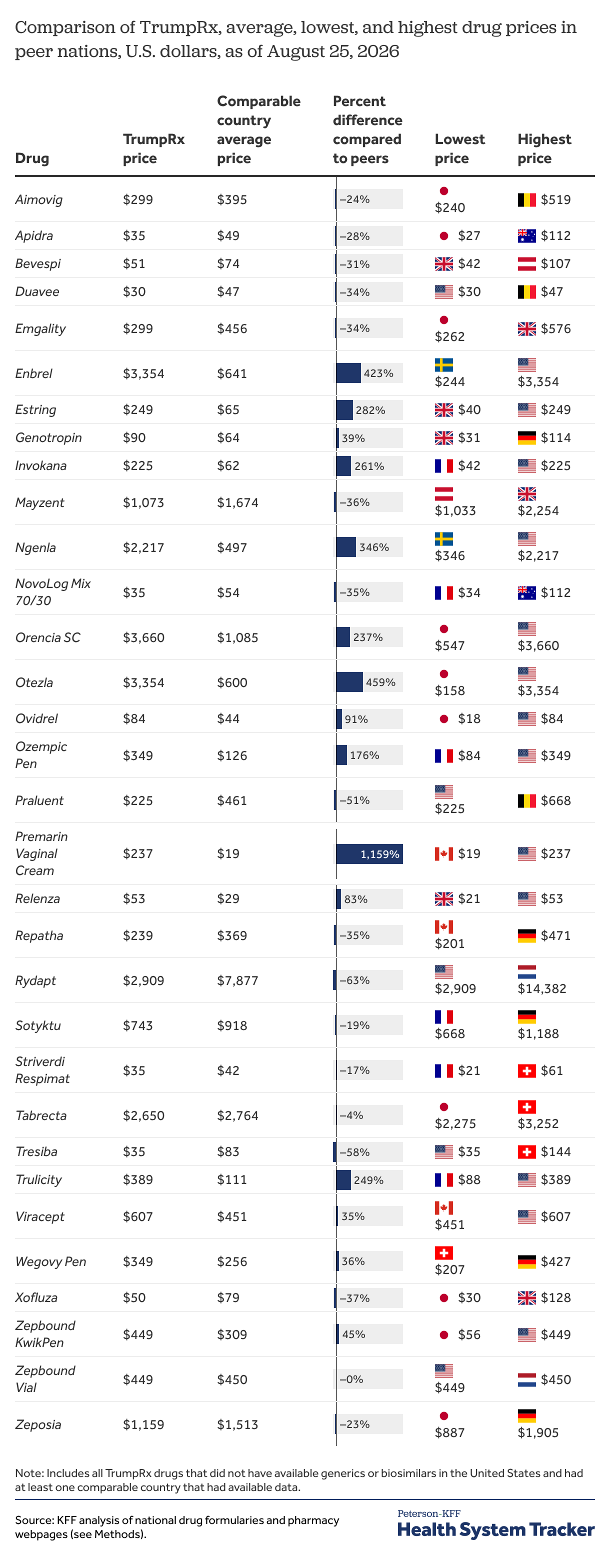
Just over half of TrumpRx prices for the 32 brand-name drugs in this analysis are lower than the average listed drug prices across the OECD peer countries. TrumpRx prices are lower than average for 17 of the 32 drugs, ranging from 1% to 63% lower than the peer average. On average, prices for these 17 drugs are 31% lower on TrumpRx than in peer nations. Eight drugs have a price that is $100 less than the peer average, typically for a month’s supply of medicine.
TrumpRx prices are higher for just under half the drugs included, and substantially higher in some cases. Among the 15 drugs in this analysis where the TrumpRx price is higher than the comparable country average, the TrumpRx price is on average 262% higher than the price in peer nations. One drug, Premarin Vaginal Cream, used for the treatment of menopause, is over 10 times the price in Canada (the only other country where it was available). For Enbrel, a drug used to treat rheumatoid arthritis, the U.S. price is $2,725 higher than the peer average ($3,354 versus $641). For nine additional drugs, the prices on TrumpRx are more than twice the average prices across peer countries (Estring, Invokana, Ngenla, Orencia SC, Otezla, Ozempic Pen, Premarin Vaginal Cream, Trulicity).
TrumpRx prices are the highest among any country for 13 of the brand-name only drugs and lowest for five
Drug prices vary widely depending on country and drug. TrumpRx prices were the highest among peer nations for 13 of the 32 brand-name drugs in this analysis. TrumpRx prices are among the highest for GLP-1 drugs, including having the highest price for Ozempic Pen ($349 compared to the next highest of $190) and Zepbound KwikPen maintenance doses ($449 compared to the next highest of $423). Only Germany has higher GLP-1 prices for Wegovy Pen ($427 versus $349).
For endocrine drugs (excluding GLP-1s), including those for diabetes, growth failure, and fertility, TrumpRx prices are higher than average for five of the 10 brand-name drugs in this analysis and the lowest for two (Duavee and Tresiba).
TrumpRx has the lowest price across all peer countries for five of the 32 brand-name drugs in this analysis. By category, TrumpRx prices are among the lowest for the available brain and nerve drugs, cardiovascular drugs, and dermatological drugs.
The U.S. provides the largest dollar discount on Rydapt, a cancer treatment drug: it is priced $3,000 lower than the price in the next highest peer country, France ($2,909 versus $5,901). The TrumpRx price is also the lowest for Duavee, a menopause drug ($30 compared to $47 in Belgium, the only other country in which it is available), Praulent, a cholesterol medication ($349 compared to the next available at $376), Zepbound, a GLP-1 for weight loss ($1 dollar less than the price in the Netherlands), and Xofluza, an influenza treatment ($50 compared to the next highest price of $128).
Factors that Lead to Differences in Prices
In contrast to the U.S., in most of the 11 peer OECD countries analyzed, a government entity is generally involved in negotiating or regulating drug prices and making coverage determinations that apply across the entire population.
Peer Countries Use Price-Setting Mechanisms
The U.S. lacks centralized price-setting or negotiating mechanisms that apply nationwide. Mainly, the U.S. private insurance market relies on private entities to negotiate rebates and discounts, while public payers rely on some combination of mandatory rebates (Medicaid), a combination of government and private price negotiation (Medicare), and statutory price ceilings paired with formulary-driven negotiation (Department of Veterans Affairs).
Outside the U.S., some countries use pricing benchmarks for cost-effectiveness. The United Kingdom, Sweden, Australia, and the Netherlands all use health technology assessments to evaluate the cost per quality-adjusted life year (QALY), which can be used to determine whether a drug’s clinical benefit justifies its cost. These assessments influence both the negotiation of the price of a drug and whether it will be covered under the national formulary in addition to other factors related to clinical practice. However, lack of coverage in a national formulary does not necessarily mean that a drug is not available, as regulatory approval and drug coverage are distinct. Approved medications, such as through the European Medicines Agency (EMA), may still be obtainable with payment fully out-of-pocket if not covered by the national health system. However, use of drugs not covered in national formularies even when approved may be lower than use of covered drugs, and formulary exclusion may result in limited access even when the drug is legally available. Prices of approved but uncovered drugs may not be publicly listed, and how they compare with the U.S. is not readily ascertainable.
Another method of price-setting is international reference pricing, used by Austria, Belgium, Canada, Japan, and Switzerland, among others, where countries use a basket of prices set by other peer countries to negotiate with drug manufacturers. Countries that use cost-effectiveness benchmarking may be included in the baskets, thereby potentially propagating some impact of pricing benchmarks. As the U.S. aims to establish MFN pricing, comparisons with peer countries could also indirectly extend the influence of QALY-based methods of pricing. Historically, the U.S. has restricted the use of QALY-based pricing in certain federal health program decisions. For example, the Inflation Reduction Act (IRA) prohibited the use of metrics such as QALYs in the negotiation process under the Drug Price Negotiation Program.
Limitations in Comparing Prices Across Nations
TrumpRx aims to bypass the complexities of the current pharmaceutical pricing chain to offer consumer savings and more transparent prices. A complication in comparing TrumpRx to international benchmarks is the difference in how the pharmaceutical supply chain and reimbursement systems affect pricing. As a result, the prices publicly available from peer OECD formularies may not reflect the cost for either wholesale or consumer prices. In some cases, the publicly listed price represents the price reimbursed by the government’s national health system (or similar entity) such as Ontario, Canada’s Ministry of Health for a particular an on-formulary drug to a heath care provider. In other cases, such as Germany, publicly available prices represent the consumer price or what a person would pay out-of-pocket without using insurance. This analysis found that for the 24 brand-name drugs that have publicly listed prices for both the U.S. and Germany, German prices are higher for 14.
As more pharmaceutical companies engage in MFN deals with the Trump administration, the effect on drug pricing in the U.S. remains uncertain. It is possible that prices for some drugs in the U.S. could change to reflect prices in peer nations, and it’s also possible that drug prices in other countries could increase as companies attempt to rebalance the pricing disparity across comparable countries.
Methods
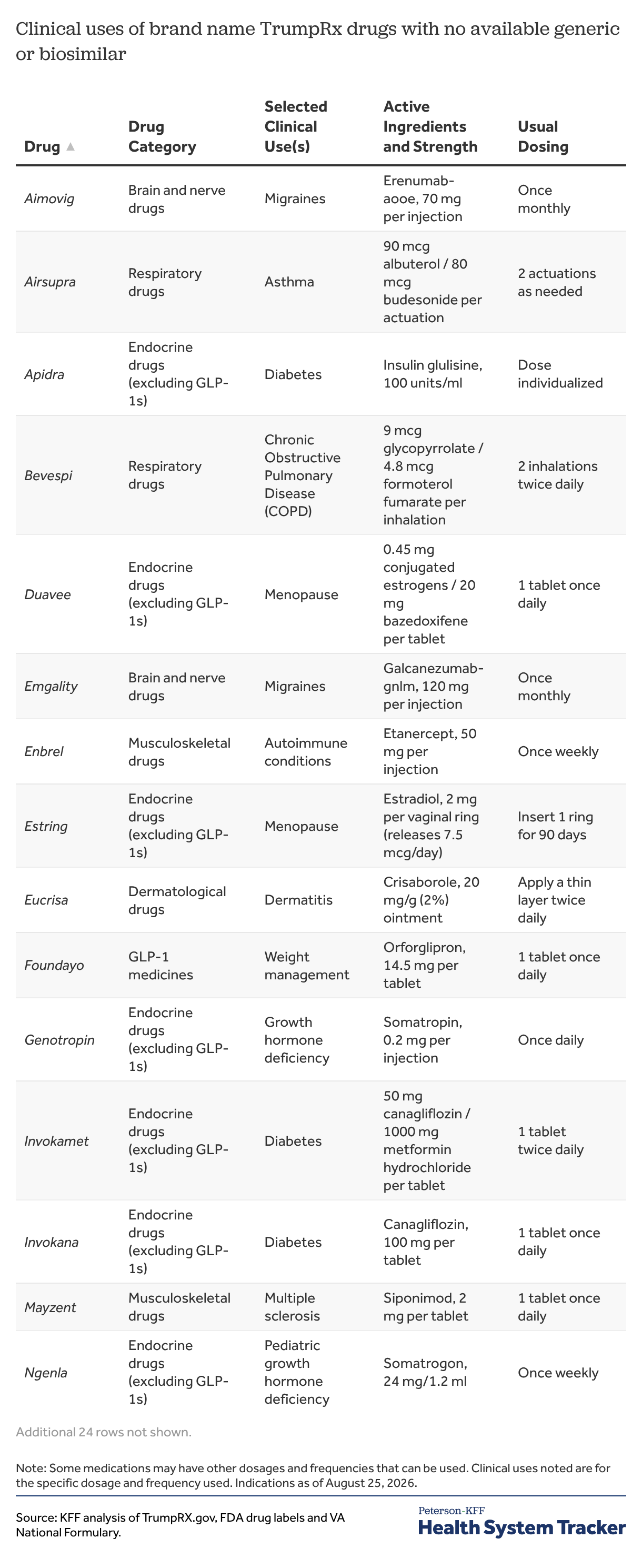
Drug prices for TrumpRx were updated on August 25, 2026. Only TrumpRx prescription drugs that did not have a generic or biosimilar available in the U.S. were selected for this analysis (39 in total, listed in the Appendix). Drugs were identified as having an authorized generic or biosimilar based on reporting from the Food and Drug Administration (FDA), the description on TrumpRx.gov, or presence of other NDCs on RxNav. Of this subset, the analysis was limited to the 32 distinct drugs that have publicly available prices in at least one of 11 selected peer nations. Most drugs had multiple strength options, of which only one strength was selected for comparison. Zepbound had multiple drug presentations, Zepbound KwikPen and Zepbound Vial, and both forms were included.
The drug ingredient tirzepatide is available under TrumpRx as Zepbound (for weight loss) but not Mounjaro (for Type 2 Diabetes). In Belgium, Germany, and Switzerland, Mounjaro, with the same active ingredient and doses, is approved for both Type 2 Diabetes and obesity or overweight; Mounjaro is compared to Zepbound for the same presentation and doses.
This analysis includes peer OECD countries that are similarly large and wealthy selected as comparators and does not adjust for the economic conditions in other countries, such as adjustment for Purchasing Power Parity (PPP). This analysis aims to represent the comparison price in USD for the TrumpRx equivalent dose.
Drug pricing information was mainly sourced from official government and health authority databases across multiple countries: Australia’s Pharmaceutical Benefits Scheme (PBS); Austria’s social insurance system; Belgium’s RIZIV-INAMI database or the Belgian Centre for Pharmacotherapeutic Information (CBIP); France’s public medicines database; Japan’s Ministry of Health, Labour and Welfare; the Netherlands’ Farmacotherapeutisch Kompas; Switzerland’s Compendium; and Sweden’s TLV price database. Canadian drug pricing differs by province, and for this analysis was obtained from the Ontario Drug Benefit Formulary as Ontario is Canada’s most populous province. Official German drug pricing does not offer the ability to track price across multiple doses or administrations, so pricing was instead obtained from the country’s largest pharmacy, Shop Apotheke. Prices from the UK were obtained from MedicinesComplete, a reference library of prescription drug information and pricing for providers of the National Health Service (NHS). Some countries (e.g., Australia, Germany) include a nominal dispensing fee for some prescriptions. All drug quantities were adjusted to match TrumpRx offerings, and drug prices in the analysis were converted to U.S. dollars using the Bank of America’s exchange rates dated September 9, 2026. International drug prices were pulled in August 2026. The drug categories were designated based on the Veterans Affairs National Formulary drug class index, updated June 2026.
Some drugs without generics or biosimilars also did not have pricing data available in other countries, including Airsupra, Eucrisa, Invokamet, Foundayo, Prempro, Zavzpret, and the pill form of Wegovy. Of these drugs, some were not approved in any country besides the U.S. (e.g., Eucrisa) or were approved but not included in the national or regional formulary.
Appendix
The Peterson Center on Healthcare and KFF are partnering to monitor how well the U.S. healthcare system is performing in terms of quality and cost.