Each year, health insurers submit rate filings to state regulators outlining their expectations for the coming year and proposing premium changes for Affordable Care Act (ACA)-compliant plans. This analysis examines filings in the small group market, which covers plans offered to small businesses (generally with 50 or fewer full-time equivalent employees). Some of this coverage is sold through state-based exchanges called the Small Business Health Options Program (SHOP), but most small group coverage is sold off-exchange directly from insurers. Insurers selling health insurance to small businesses generally have to comply with ACA rules.
For 2027, the median proposed premium increase among 295 small group insurers across all 50 states and the District of Columbia is 14%, based on data published on the federal website ratereview.healthcare.gov. Most small group market insurers (59%) are raising rates between 10 and 20%. A more detailed review of 82 insurer filings from the 14 states and D.C. with the earliest available unredacted filings shows that insurers cite rising medical prices and utilization as a primary driver of premium increases. Other contributing factors include new high-cost specialty drugs, increased GLP-1 utilization, and increased behavioral health utilization. Some insurers also note the declining enrollment and worsening risk pool morbidity – in some cases specifically attributed to the rise in level-funding by small businesses (a form of self-insurance) – as a factor leading to higher projected costs next year.
How are premiums going to change in 2027?
Insurers in the small group market are proposing a median premium increase of about 14% in 2027
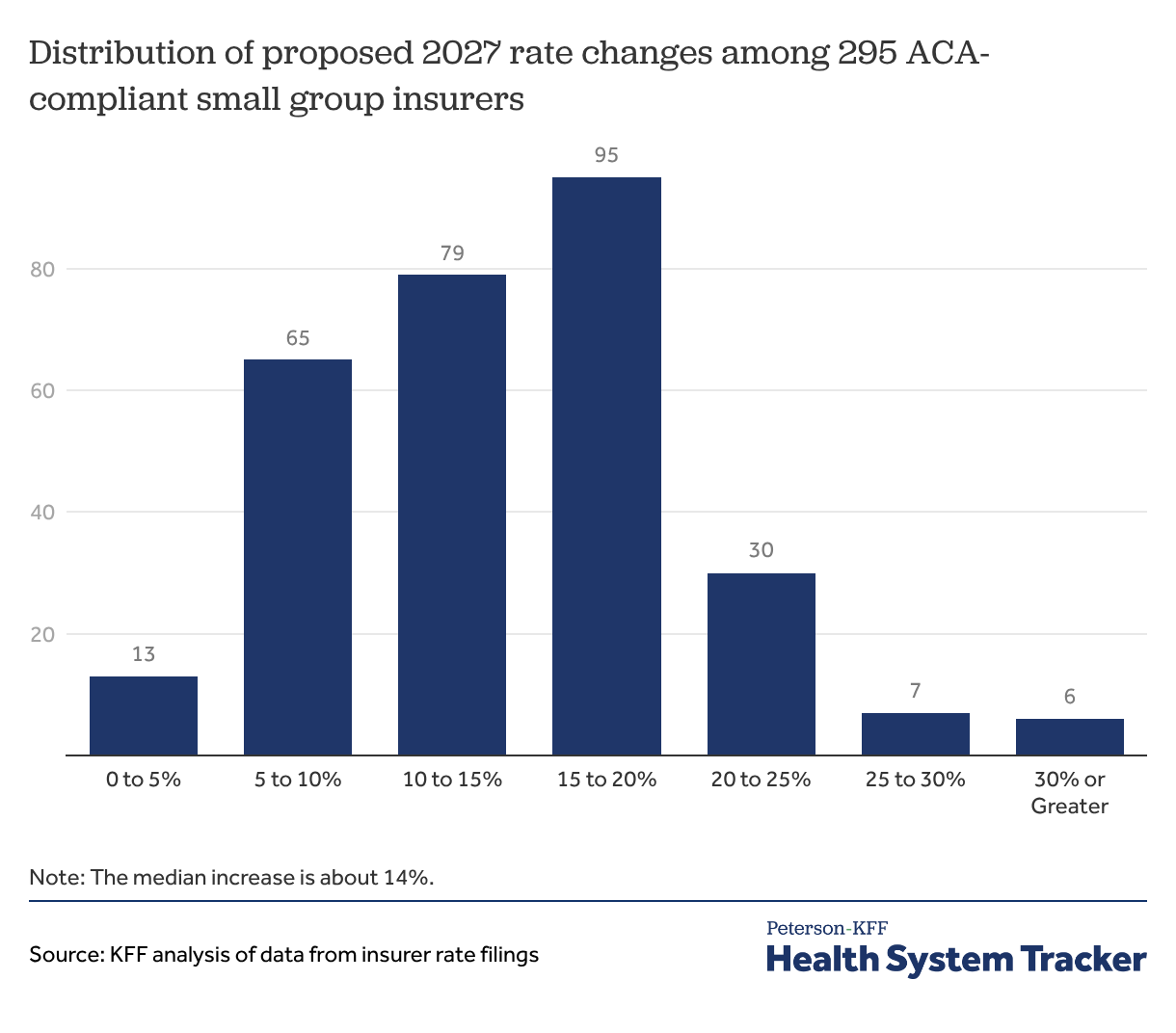
Each insurer submits to state regulators a detailed filing justifying their rate increases for the coming year. These rate filings include an average proposed premium increase for each insurer that is weighted based on the insurers’ projections of how enrollment in each of its products will change in the coming year. The median across these insurers’ weighted average proposed increases is 14%; the 25th percentile is 10% and the 75th percentile is 18%. Insurers also generally include narrative descriptions explaining some of the trends they are experiencing and the assumptions they are making relating to how healthcare costs and risk pool will change in the coming year, though states and insurers differ in how much of this narrative is made public.
What is driving premium increases?
The remainder of this analysis focuses on a subset of these rate filings from 82 insurers across 14 states and D.C., which were reviewed in more detail to better understand the factors driving premium changes in 2027. These states make rate filings available earlier than the federal rate review website, and the filings are generally much more transparent and less redacted, allowing for a more thorough understanding of the drivers of premium growth. States in this section include Connecticut, Hawaii, Illinois, Iowa, Kansas, Maine, Maryland, Massachusetts, Michigan, New York, Oregon, Rhode Island, Vermont and Washington, as well as Washington D.C. For context, across the 14 states and D.C. reviewed in this section, insurers have a median proposed rate increase of 14%, as is the case nationally.
Rising healthcare costs
Similar to the individual market, rising underlying medical costs are a major driver of proposed premium increases in the small group market. For 2027, the median insurer estimate of the underlying increase in the cost of healthcare (medical trend, which is a function of price and utilization) is 10.8%. Insurers note that the costs of services, such as hospitalizations and physician care, and prescription drugs continue to rise annually, and many plans have seen increased utilization. This prompts premium adjustments to keep pace with increased expenditures.
Related Content:

“The primary driver of the rate increase continues to be rising healthcare costs, composed of higher than expected levels of claims experience during the base period, increased healthcare utilization, and more expensive healthcare services.” -Premera Blue Cross, Washington
“Costs for medical care and medications for our members have escalated rapidly and spending is now growing at the fastest rate in more than a decade. The surge in spending is putting a heavy burden on our employer customers and members who are struggling to keep up with rising costs.” -Blue Cross and Blue Shield of Massachusetts HMO Blue, Inc., Massachusetts
“Increases in the use and cost of medical services, prescription drugs, and other health care expenses contribute to higher overall health care spending each year and increase the premium needed to cover expected costs.” -Oxford Health Insurance, Inc., New York
High-cost specialty drugs
The increasing cost, prevalence, and utilization of specialty drugs are frequently mentioned by insurers in justifying proposed rate increases. Most insurers do not specify a single drug or condition when discussing these high-cost specialty drugs, but refer to the proliferation of expensive emerging drugs generally. Several plans point out that many of these drugs are new and do not have generic or lower-cost alternatives available yet, leaving plans responsible for paying the full cost and subsequently driving up premiums.
“The impact of blockbuster high-cost biologics, and other innovative emerging therapies has a material impact on current trends. These dynamics put added pressure on medical claims, which in turn causes premiums to increase.” -Blue Cross and Blue Shield of Massachusetts HMO Blue, Inc., Massachusetts
“High Rx cost trends are driven by the increased prevalence of specialty drugs in the market, new specialty drugs expected to be introduced, the high cost per specialty prescription, and the lack of low cost substitutes for these drugs.” -Regence BlueCross BlueShield of Oregon, Oregon
“However, the savings trend associated with generics is being eclipsed by another trend around the rising cost and utilization of specialty medications including biologics. Every year more and more highly complex specialty medications are approved by the FDA to treat both rare and sometimes more common diseases. Specialty medications are used by approximately 2 percent of our members, but they account for more than 50 percent of total drug spend.” -Excellus Health Plan, Inc., New York
GLP-1 medications
Consistent with premium changes in the individual market, a number of insurers mention GLP-1 medications in their premium rate filings. Some insurers decided to discontinue coverage for GLP-1 medications used specifically for weight loss and others may never have covered these medications for weight loss purposes, but nevertheless still see rising costs, as utilization among diabetes patients continues to increase.
“Despite discontinuing coverage for GLP-1s for weight loss, we continue to see rising utilization for diabetic GLP-1s as these treatments increasingly are being used to treat diabetes and expanded for other conditions.” -Mass General Brigham Health Plan, Inc., Massachusetts
“While anti-obesity GLP-1 drugs are excluded, a certain portion of members are expected to transition to diabetes-indicated GLP-1 therapies, where clinically appropriate, resulting in continued utilization of these high-cost medications.” -Boston Medical Center Health Plan, Inc., Massachusetts
Other insurers that are covering GLP-1s for weight loss say these drugs are continuing to put significant upward pressure on their premiums.
“We have increased the index rate by 2.4% to account for the coverage of medically necessary anti-obesity medications, including new, high-cost branded medications. We expect this to continue to increase due to the requirement under Regulation 62 to review these cases for medical necessity. This rate impact associated with GLP-1s is separate from previously mentioned trend adjustments.” -UnitedHealthcare Insurance Company of NY, New York
Behavioral health
In recent years, spending on mental health and substance use disorder treatment has increased, driven by increased utilization of behavioral health services. A number of insurers report that this increased utilization of mental health and substance use services contributes to higher premiums.
“Behavioral health, while still a smaller share of total spending, has experienced rapid growth – exceeding 20% annually over the past two years – driven by higher utilization and increased provider rates. Although recent WellSense’s insourcing efforts and contract negotiations may help moderate this trend, utilization is expected to remain elevated.” -Boston Medical Center Health Plan, Inc., Massachusetts
No Surprises Act
The No Surprises Act (NSA), enacted in 2022, introduced consumer protections against certain surprise medical bills, most notably by requiring that patients who receive out-of-network services at in-network facilities be charged only for in-network cost sharing. To resolve payment disputes between providers and insurers, the NSA instituted an independent dispute resolution (IDR) process. In practice, providers have initiated a large majority of payment disputes and have prevailed in most of them, frequently securing payments exceeding the median in-network rate, driving up costs for insurers and contributing to higher premiums, an outcome that stood in stark contrast to projections from the Congressional Budget Office. The IDR process has also faced a series of legal challenges since its inception, creating ongoing uncertainty around its implementation and scope. Two small group insurers mentioned the No Surprises Act as a driver of healthcare costs.
“Additionally, a 0.8% increase has been added for costs associated with the Independent Dispute Resolution process, including both the federal program and additional New York-specific requirements.” -Oxford Health Insurance, Inc., New York
“Changes in state-mandated benefits and other regulatory requirements account for 3.5% of the requested rate change. Of this impact, 2.4% is attributable to expanded coverage of medically necessary GLP-1s, 0.3% is attributable to network adequacy requirements, and 0.8% is for costs associated with the Independent Dispute Resolution process, including both the federal program and additional New York-specific requirements.” -UnitedHealthcare Insurance Company of NY, New York
Risk pool deterioration and level-funding
Many insurers cite declining enrollment across small group plans as a driver of increased per-enrollee spending. Several plans state that this is due to groups with healthier, lower-cost members leaving the fully-insured market for lower-premium options, discussed more below. This drives premiums for fully-insured plans higher, as remaining groups have less healthy and more expensive enrollees on average.
“The overall enrollment decreasing may signify lower cost small groups finding more favorable rates elsewhere, resulting in a higher cost enrollment pool remaining.” -Moda Health Plan, Inc., Oregon
“Between March of 2025 and March of 2026, CDPHP UBI small group enrollment dropped by 33%. The demographic makeup of the pool was reviewed and found that the change in average Milliman demographic risk factor for UBI indicated a 1.6% increase, which is higher than historical norms. CDPHP UBI has made a 1.2% adjustment (see Line 46a in Exhibit 18) to account for the increased risk of the pool after this substantial loss of enrollment.” –CDPHP Universal Benefits Inc., New York
“Based on the characteristics of groups insured in the current book of business, we have considered the possibility that small employers may drop out of the fully insured health insurance market, and thus cause a potential change in the morbidity of the fully insured population. The risk identified as small employer drop out risk is included in URRT “Morbidity Adjustment” category on Worksheet 1 of the URRT. The claims were adjusted by 3%, to align with the expected rating period single risk pool morbidity level.” — UnitedHealthcare Insurance Company, Kansas
One reason insurers say the fully-insured risk pool is deteriorating is the increase in self-funded, and specifically level-funded, arrangements for small businesses. The plans are referred to as level-funded because employers pay a fixed amount each month, but may receive a rebate if actual health care claims are lower than expected. Level-funded plans allow small groups typically with healthier enrollees to exit the fully-insured small group risk pool and pay lower premiums due to their lower expected costs.
“From January 2024 to December 2025, we had 347 members convert from UHC ACA coverage to a LF [level-funded] arrangements. Unfortunately, we are unable to track how many members have moved from a competitor’s ACA plan to a LF arrangement.” -UnitedHealthcare Insurance Company, Rhode Island
“We are seeing a growth of self-insured “level funded” small group options, from 2 percent in 2021 to over 11 percent in 2025 (based on the Center for Health Information and Analysis (CHIA) Enrollment Trends Databook as of September 2025). These products are medically underwritten which pulls small groups with favorable risk out of the merged market risk pool, leading to a deterioration of the fully insured merged market risk pool and worsening affordability for individuals and small businesses who remain in the merged market.” -Mass General Brigham Health Plan, Inc., Massachusetts
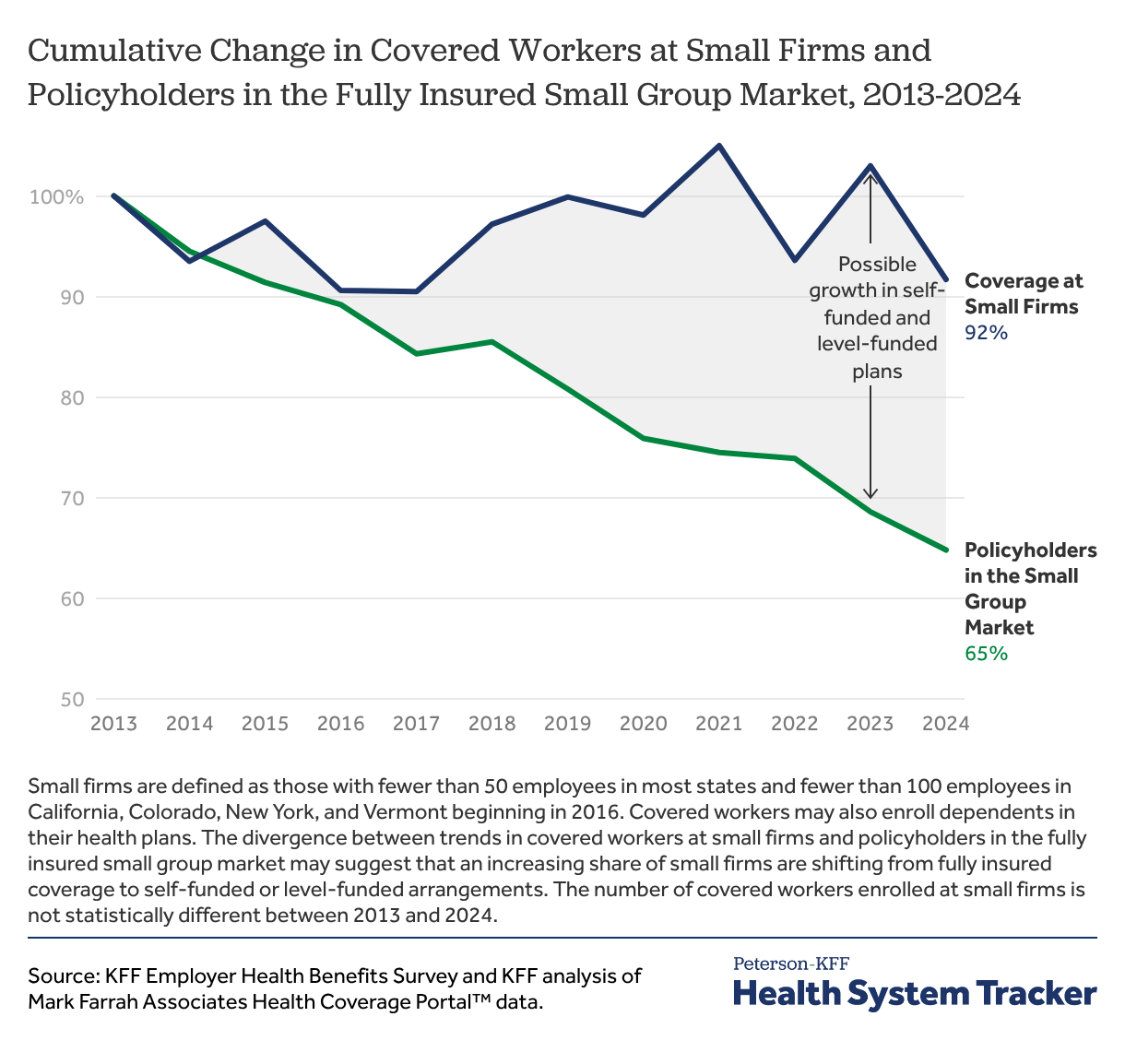
These proposed premium increases follow years of declining enrollment in the fully-insured small group market. Since 2013 (the earliest available data and before most ACA insurance rules went into effect), the number of people covered in the fully-insured small group market declined from about 17 million to about 10 million people in 2024, a drop of 41% in the number of covered lives or a drop of 35% in the number of policyholders, according to KFF analysis of data compiled by Mark Farrah Associates TM. At the same time, employer surveys, including KFF’s Employer Health Benefits Survey, show that coverage rates (of any type of health insurance arrangement) among people employed at small businesses has been steady, with the number of workers covered by small employers statistically similar over the same period (8% decrease). Other data suggests there has been a simultaneous increase in the number of people in self-funded plans. This discrepancy suggests that many small employers have shifted from fully insured coverage to self-funded or level-funded products rather than dropping health coverage altogether.
Coverage at Small Firms Has Remained Steady While the Fully Insured Small Group Market Has Contracted
Unlike fully insured small group plans, level-funded arrangements are generally not subject to state insurance regulations or the ACA’s small-group rating and benefit requirements, such as guaranteed issue, community rating, and essential health benefit requirements. This means insurers offering a level-funded plan can first consider the health status, gender balance, or other factors of the employees before deciding whether to offer a level-funded plan or how much to charge.
For some employers with healthier employees, a level-funded arrangement may allow them to lower up-front premiums or receive refunds based on the group’s actual health costs. It may also allow them to avoid some premium taxes and have more flexibility over which benefits they offer.
However, these arrangements also provide fewer protections than ACA-compliant small group coverage. For example, these arrangements are not guaranteed renewable, meaning employers with unexpectedly high claims may face substantially higher renewal costs or may not be able renew the plan at all. Employees enrolled in these arrangements may lose ACA and state consumer protections, as level-funded plans may not cover all of the essential health benefits or state required benefits.
Insurer rate filings indicate that continued growth in the popularity of alternative coverage options for small businesses, like level-funded plans, has the potential to further erode the fully-insured small group risk pool and could contribute to future premium increases for small businesses, particularly those with sicker employees who may not qualify for or are priced out of a level-funded arrangement.
Methods
Proposed rates were collected from RateReview.Healthcare.gov. The 14% increase is the median across all insurers filing rate increases from 50 states and DC and is not weighted by enrollment at each insurer, and therefore may not reflect the average increase that enrollees see.
Additionally, 82 insurer actuarial memoranda were collected from state rate review websites. Actuarial memoranda were systematically evaluated for key words related to, but not limited to, medical trend, level- and self-funding, tariffs, enrollment changes, risk morbidity changes, Individual Coverage Health Reimbursement Arrangements (ICHRAs), specialty medicine, market consolidation, and diabetes or weight loss drugs. Recorded medical trend values are annualized and do not include leveraging.
Appendix
The Peterson Center on Healthcare and KFF are partnering to monitor how well the U.S. healthcare system is performing in terms of quality and cost.