Introduction
The hospital price transparency (HPT) rule, promulgated by the Centers for Medicare & Medicaid Services (CMS) in 2021, requires most non-federal hospitals to publish their standard charges for each item and service they provide. Hospitals must release a machine-readable file (MRF) with fields describing their standard charges at least annually. These elements include the gross charge, the discounted cash price, and payer-specific charge information, as well as context for the charges, such as a description of the service, the billing code, the method of payment (e.g., dollar case rate, per diem rate, percent of charges), setting (e.g., inpatient, outpatient). For negotiated charges, this file must also include the payer and plan names with whom the charge has been agreed.
The most recent revisions took effect in January 2026 with enforcement beginning in April 2026. These revisions, combined with an updated schema and new guidance (i.e., format for the reporting) from CMS, clarify how hospitals should encode information about rates negotiated with third-party payers. Two key points of emphasis in the revised rule are that (1) hospitals must encode rates as a dollar value whenever a final rate can be determined in advance of service and (2) hospitals need to encode new “allowed amounts” that hospitals must provide if a rate is encoded as a percentage (i.e., a percentage of charges) or an algorithm (i.e., a formula that cannot be determined prior to service). The idea that hospitals need to encode rates as dollar values when they can is not new to this version of the rule, but new provisions, such as the requirement that hospitals attest that all rates that can be expressed as dollar amounts have been encoded that way[1], strongly emphasize the point. The new allowed amounts are intended to provide more detailed price information—a median and percentile amounts of actual payments, as well as a count of payments to show how often a hospital has been reimbursed for the service—for arrangements when a final dollar amount cannot be estimated prior to service. CMS suggested that the new provisions will improve the transparency of prices and the comparability of negotiated payment arrangements across hospitals.[2]
To begin to understand how these new provisions might affect the comparability of rates being encoded by hospitals, rates for two common admission codes in several local markets were reviewed using HPT data aggregated by Turquoise Health. One clear improvement from the new provisions and guidance is that the reporting instructions are clearer and more precise, something that has progressed with each new version of the rule. There also is clearer guidance of when a rate can be determined in advance of service (e.g., a rate that is a percentage of Medicare is usually calculated in advance), which should allow more rates to be expressed that way.
Reviewing the sample rates, however, also revealed several items that can complicate the comparability of rates, which are discussed with examples below. In some cases these items may be resolved through clearer guidance, while others may be be more difficult to resolve. They include:
- The data element for encoding dollar amounts is used for both base rates and for final rates. Base rates are initial rates that later may be adjusted by a percentage or formula that cannot be determined in advance of service. This means that data users need to inspect other data elements, including free-text data elements, to understand whether an encoded dollar amount is a base or final rate. Interpreting the free-text data elements is fairly straightforward when inspecting a small number of rates, but is difficult for any kind of systematic analysis.
- Sometimes a rate arrangement is reported as more than one rate for the same hospital, payer and plan combination. This is particularly common for arrangements where payment consists of a set rate for a certain number of days, with a per diem amount for additional days of an admission, but there are other instances of this issue as well. This is an area that CMS may be able to resolve with further guidance, but until that time, users need to be aware of situations that may appear to have multiple rates for the same hospital, payer and plan combination but actually may be part of the same arrangement.
- There is inconsistency across hospitals about whether certain information is encoded in the algorithm data element or in the note data element. Although CMS has issued guidance instructing hospitals as to when to encode arrangements as algorithms, users cannot reliably expect that hospitals will encode information in the correct data element. This matters because encoding information as an algorithm requires hospitals to encode additional information about actual payments received; this generally does not happen when the information is encoded as a note.
- There is inconsistency in how hospitals encode stop loss or other outlier payment arrangements with payers. These are arrangements where a hospital and payer negotiate an alternative or additional payment approach or amount when specified conditions occur, such as the the charges for a patient exceeding a certain amount or a length of stay exceed a specified number of days. CMS has recognized some of the issues here and recently issued guidance that addresses some but not all of the issues facing hospitals and users.
- The new allowed amount data elements often contain no information because no payments have been made by the plan to the hospital for the service during the prior year. These new allowed amounts were intended to increase the comparability of rates by providing some actual payment information for cases where a dollar value cannot be calculated prior to services being provided, but in the large majority of these cases, no payment information is available. This has several implications. One is that it suggests that the HPT data, like the Transparency in Coverage (TiC) data reported by payers, has a significant proportion of rates that are never paid. Unfortunately, because the count information is reported for only a subset of rates (those reported as a percentage or an algorithm), users are left to wonder about the status of other rates where this information is not required. A second, more practical question is what to do with the dollar rates that also are reported with an algorithm or percentage but with a count of zero. Users may choose to ignore these rates, but there really is no way of knowing whether they are any more valid than any other rate reported as a dollar value.
These complications reflect the complexity of payment arrangements between hospitals and payers. The HPT rule allows for, and in some cases requires, hospitals to encode detailed descriptions of the factors and methods used in calculating final rates. These descriptions are encoded in free-text algorithm or notes data elements, providing context for understanding the rates and often including important limitations (e.g., the case rate applies only to days 1 and 2 of a stay). Reviewing the algorithm and notes data elements can be crucial to understanding the actual rates paid to hospitals for a service.
Related Content:
An important context for this discussion is distinguishing between different types of users of the HPT files, because factors that may be useful to some users may raise significant complications for others. Market participants, such as hospitals, health plans, and consultants, who may be using the information for tasks such as setting prices, negotiating rates, or evaluating market positions, likely will want to review all of the details that are available, and, to the extent that their use is focused on geographic markets or particular providers and payers, they will be able to review all of this detail inside of the free-text data elements and apply their experience to understanding the context that it may provide. They also may have claims data or other market-specific information that they can compare to the HPT data and help provide context to what they are seeing.
In contrast, users who may be estimating prices across a broader number of markets, hospitals, or payers may not have the capacity to review all of the information in all of the data elements for each rate they would like to use. These types of analyses will tend to focus on the dollar values in the negotiated dollar data element, perhaps adding median or percentile amounts where available, across a relatively large number of hospitals, payers or locations. These users may include researchers as well as those developing platforms or applications to provide dollar rates to consumers. Trying to incorporate information from non-standard, free-text data elements into this type of analysis in any standardized way can be extremely time consuming, but this information may be crucial to understanding which rates are appropriate to use and as well as how to use them. A potential approach might be to just use dollar rates where there is no other information, but this could be quite limiting and biased.
The discussion and examples below are presented as a first look, rather than a deep dive, into some of these new provisions. Hospitals may take some time to adapt to the new requirements and CMS likely will continue to update guidance in response to questions or issues raised by hospital MRFs. For example, CMS issued new guidance and a Request for Information (RFI) relating to encoding outlier arrangements, seeking public, this summer.
Background
The negotiated arrangements between hospitals and payers can take a number of forms that vary in their complexity. For an admission, a hospital might be paid a dollar amount for the stay, a per diem payment for each day of the stay, a percentage of the charges (i.e., list prices) accumulated during the stay, or an amount derived from a formula that might incorporate different methods or be based on contingencies that arise during the stay. Payment amounts may be further subject to stop loss, outlier, or other contingent payments based on factors such as the total accumulated charges or length of the admission. The methods used vary within and across hospitals and payers.
This complexity makes the task of capturing rates in ways that make them both reasonably accurate and reasonably comparable difficult. The HPT rule attempts to reach this balance by requiring that a negotiated rate be encoded as a dollar value whenever the final amount can be determined before services are provided, but then allowing rates to be reported as a percentage or an algorithm when that is not possible. For example, if a rate is negotiated as a percentage of a known fee schedule, such as a percentage of Medicare, the hospital must calculate the amount and encode a dollar amount rather than reporting the rate as a percentage. The schema also has two free-text additional notes data elements (“Additional Generic Notes” or “Additional Payer-Specific Notes”) that hospitals use to explain or provide context for a rate; for this example, a hospital might note that the dollar amount was calculated as a percentage of Medicare. The use of the additional text data element is required in some circumstances and optional in others.
Only when a rate cannot be determined in advance—such as a rate that is a percentage of charges accumulated during the stay or a rate that varies the method or amount by the length of stay—are hospitals instructed to encode the rate information as a percentage or an algorithm. An algorithm is a free-text data element that a hospital uses to describe the factors, contingencies, amounts, and other information that determine the final rate. These entries can be quite simple and short (e.g., “66.6% of billed”) or can span hundreds of words (see examples below). Hospitals that encode rates as percentages or algorithms must also encode allowed amount information for the rate. This includes a median amount and 10th and 90th percentile amounts calculated from the payments that the hospital has received from the payer and plan for the item or service over the last 12 to 15 months, as well as a count of the number of payments that the hospital used to calculate these amounts. If the hospital has received no payments from the payer for the plan for the item or service within the 12 to 15 month look-back period, the hospital is instructed to encode a count of “0” and to explain that it has not had any claims in the additional notes data element.
Hospitals also are instructed to encode a contract method for each rate, indicating whether it is a “case rate,” a “per diem” rate, based on a “fee schedule,” or a “percent of total billed charges;” if none of these apply, “other” is to be encoded and the arrangement must be described in detail in the notes data element.
Taken together, these instructions are intended to enable users trying to identify rates that can be readily compared for an item or service. The requirement to report final rates as dollar amounts whenever possible allows for comparing many of the reported rates, and the contract methodology separates those that reflect a total amount (i.e., case and fee-schedule rates) from those that are paid per diem. When a final dollar rate value is not available (i.e., rates are reported as a percentage or algorithm), users have an option to use the allowed amount information, if available, for a rate to make comparisons to the total dollar amounts otherwise reported.
As noted above, however, there are aspects of the rule and schema that complicate the task of identifying comparable rates, and differences in how hospitals interpret the schema or report similar arrangements create additional difficulties for users. Some of these issues are illustrated and discussed below.
Rate Comparison Issues and Examples
Understanding the “Negotiated Dollar” Element
The negotiated dollar data element is used for both base rates and final rates. One aspect of the rule that can confuse users is that hospitals are instructed to encode a dollar value in the negotiated dollar data element both when the rate is a final rate and when it is a base rate that may be further adjusted by a percentage, algorithm, or both. In the latter case, a rate arrangement is reported with information in two or all three of the negotiated dollar, negotiated percentage, and negotiated algorithm data elements. This means that users cannot rely on reported dollar amounts to be final rates, and that they need to consult multiple data elements, including a free-text data element in the case of a dollar rate that is also reported with an algorithm, to determine whether or not a negotiated dollar value is a final rate. Examples of these arrangements are illustrated in Tables 1 and 2.
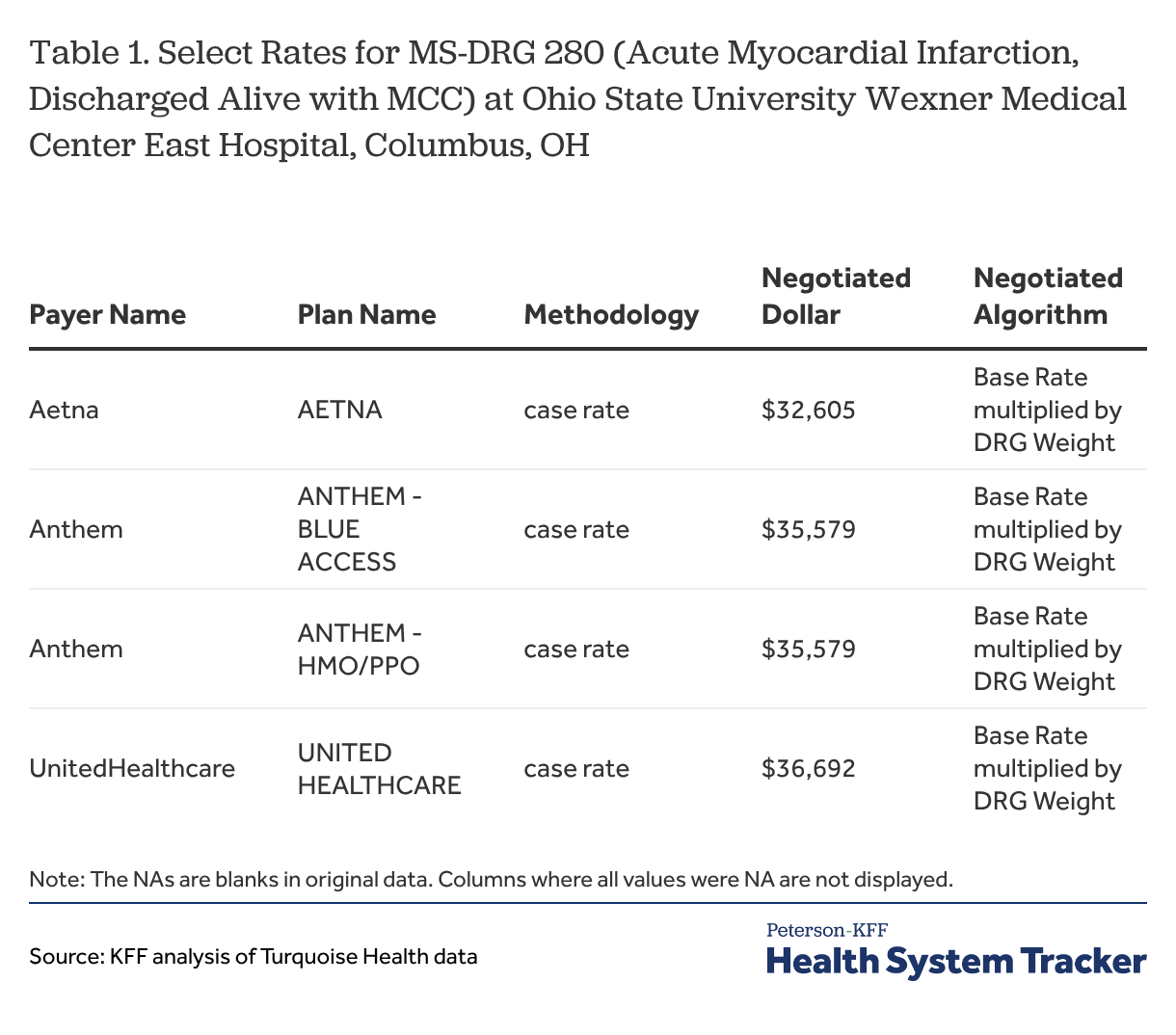
A few observations can be made from Table 1, which shows select rates for MS-DRG 280 (Acute Myocardial Infarction, Discharged Alive with Multiple Chronic Conditions) at Ohio State University Wexner Medical Center East Hospital. One is that the reported negotiated dollar amounts differ from the median and percentile amounts that are based on actual payments, although the numbers of cases underlying those amounts are not large. Those payments also might reflect prior contract amounts or terms, which is something that users cannot know. A second observation is that the algorithm encoded by the hospital for these arrangements is vague and is not the detailed description required by the schema. Given the variation in the allowed amounts, it may be that some key information is being omitted from the algorithm description. The key takeaway, however, is that users need to review multiple columns in order to understand what is going on with each of the reported rates, which would be difficult with any kind of systematic analysis.
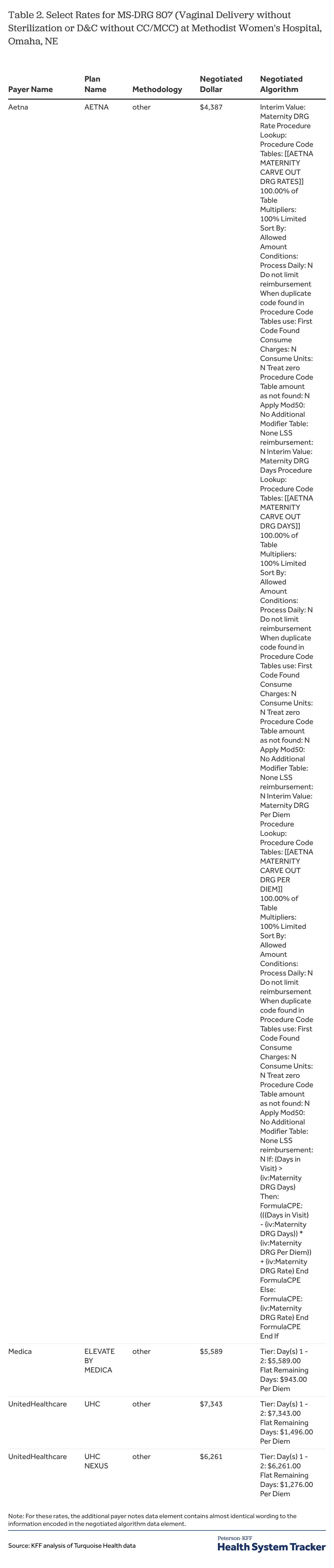
The algorithms in Table 2, which shows select rates for MS-DRG 807 (Vaginal Delivery without Sterilization or D&C without CC/MCC) at Methodist Women’s Hospital in Omaha, are much more detailed and, other than the one encoded for the Aetna arrangement, describe the payment terms in ways that can be easily understood by users. For these cases, the reported dollar amounts are base rates that apply for stays of one or two days, but are adjusted with additional per diem amounts for each additional day in a stay. As with the previous example, users would need to observe the free-text algorithm data element (or the almost identical information contained in the additional payer notes data element, which is not shown) to understand the rate arrangements. Examining the free-text data element may be possible for a small number of cases, but quite difficult to do systematically.
An additional observation from Table 2 is that the payment counts upon which the median and percentile amounts are calculated are in most cases much larger than the counts in Table 1. There are several potential reasons for this: one is that births are much more common than heart attacks in the commercial population; another is that the counts in Table 2 include payments to more than one related hospital – the exact same rates, counts, medians and percentiles were reported for the same payer and plan combinations at another Methodist hospital in the city. Several issues relating to the allowed amount counts data element, including the large share with zero or low values and the somewhat ambiguous guidance around how the count should be calculated, are discussed further below.
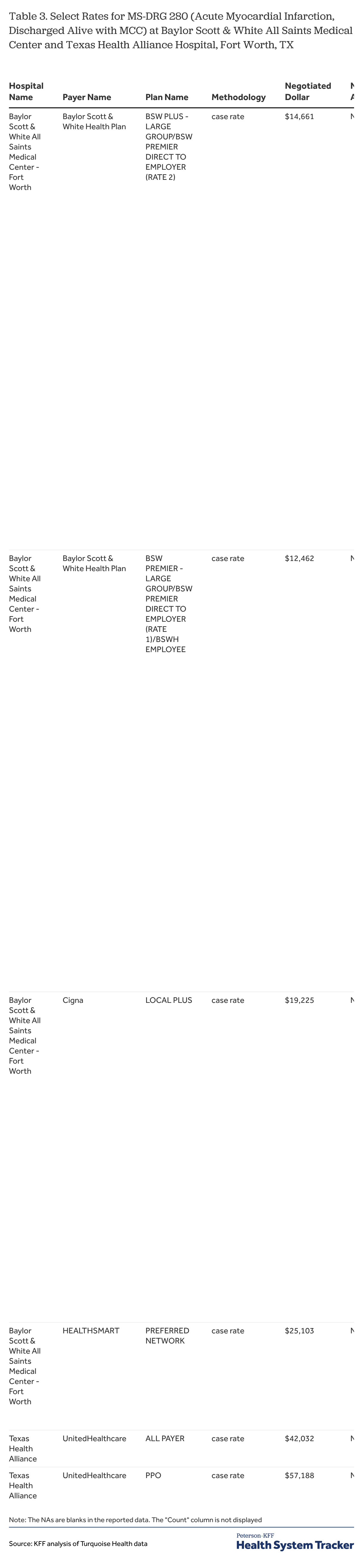
There is inconsistency in how hospitals use the negotiated algorithm and the additional notes data elements. Another area of potential confusion is that some information reported as notes may actually be algorithms. The schema describes the additional generic notes data element as “a free text data element to help explain any of the data including, for example, lack of applicable data, charity care policies or other contextual information that aids in the comprehension of the standard charges.” There also is an additional payer notes data element in one of the three schema formats[3]. In some cases the information encoded in these data elements goes beyond providing explanation or context to describing formulas or conditional arrangements that adjust or limit the reported rate and which meet the definition of an algorithm.
The “Additional Generic Notes” illustrated in Table 3 each suggest that the final rate is in some way subject to factors that cannot be known in advance—either the length of stay or the amount of billed charges accumulated during the stay. Because these rates were reported as case rates without an algorithm, some users might just use them in statistical analyses without recognizing that they are not necessarily the final rate. In several of these arrangements, payment of a per diem for days beyond the geometric mean length of stay (which is 5.3 days for Medicare beneficiaries) might cause a meaningful difference between the initial amount and the final rate; this is at least a factor that users would want to consider in determining whether and how to include the rate in their analyses.
Reporting this type of information as a note, rather than an algorithm, has several implications for users. One is that users need to observe the information in these free-text notes data elements, even for rates reported as case rates. This is a bigger issue for researchers or others analyzing large numbers of rates, because reviewing these data elements is far more complex and labor intensive than simply accessing the negotiated dollar amounts. For industry participants and others reviewing a small number of arrangements, the additional effort is less onerous, and the information is crucial to understanding how rate arrangements are structured in the market. A second implication, which affects all types of users, is that hospitals that report information this way generally do not encode information in the allowed amount data elements, which means that users do not get the benefit of the allowed amount count or the median and percentile values. This negates an important aspect of the revised rule and meaningfully limits how the rates might be understood.
Understanding Outlier Arrangements
Even with recent guidance, encoding and understanding stop loss and other outlier arrangements can be confusing for hospitals and users. Many rates are subject to stop loss or other payment arrangements where the terms change when the circumstances of the case might be considered to lie outside expected values. These arrangements generally provide for a different, often higher, payment when certain metrics occur during a stay or service, such as billed charges exceeding a specified amount or a stay exceeding a specified period. The terms of these arrangements range from the relatively straightforward to the quite complicated. They also vary in how often they are likely to be invoked: some apply only when charges exceed a large dollar amount while others may be triggered when an admission exceeds the average length of stay. These present quite different scenarios for users trying to ascertain what a final rate is likely to be.
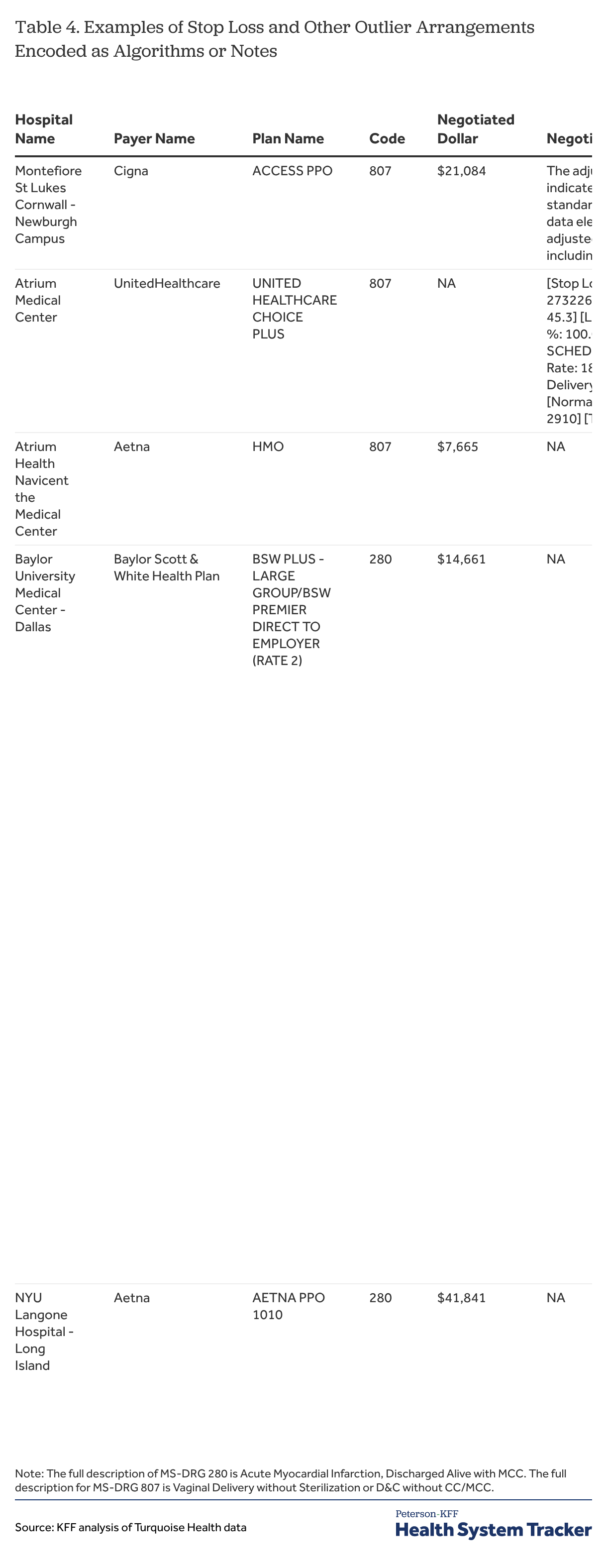
Many hospitals encode rates with information indicating that the rate is subject to an outlier, stop loss, or similar provision. Some hospitals encode this information as an algorithm, some in a notes data element, and some in both fields. Under the rule and schema, hospitals also have the option to encode these arrangements as general contract provisions, however, the data from Turquoise Health does not currently include information from the optional general contract provisions data element, so hospital use of this data element could not be explored. A few examples of the different ways that hospitals are reporting these arrangements as algorithms or notes are shown in Table 4. Other examples are shown in the above tables as well.
CMS has recognized that this is an area of confusion for hospitals and users and recently issued recommended guidance as to how these arrangements may be encoded. More specifically, for arrangements with a payer that apply at an aggregate level across the contract or multiple items and services, a hospital may use the optional general contract provisions data element. CMS provides an example of this: “When total claim charges exceed $200,000.00 for a Platform Health Insurance plan, the entire claim will be reimbursed at 50% of charges.” The schema suggests that hospitals may encode multiple general contract provisions in this data element. For arrangements that are specific to an individual item or service, the arrangement should be encoded as an algorithm. The new guidance cautions that hospitals should not use an additional notes data element to encode these arrangements, although many hospitals currently do so.
In addition to this guidance, CMS recently issued an RFI seeking public feedback on the need for more standardization in the encoding of outlier provisions and other additional contract terms (91 FR 41997). The agency noted:
“Given the importance of such provisions in hospital contracts and evidence gathered from our experience with compliance reviews and interested parties’ feedback, which has shown the need to more clearly indicate whether and when such provisions apply in the MRFs, we anticipate providing additional guidance to support even more clear and accurate reporting of this information and proposing additional requirements through future notice and comment rulemaking.”
Although the recommendations in the new guidance directly address one of the current issues facing data users, several other potential issues remain for hospitals and users reporting under the current rule and schema:
- One issue that is directly addressed by the new guidance is the use of the additional notes data elements to report these arrangements. Many hospitals now do this. As discussed above, when hospitals encode information about arrangements that can adjust the final rate in a notes data element rather than as an algorithm, it requires users to observe an additional free-text data element and deprives users of the information in the allowed amount data elements.
- The question of how to address the distinction between general contract provisions and negotiated algorithms is less clearly resolved in the guidance, and it has important implications for data users. For example, the guidance provides that hospitals may use the general contract provision data element when an arrangement applies “across a payer contract or to multiple items or services.” There is, however, a great deal of room between “all” services under a contract and “multiple” items or services: multiple simply means more than one. Does this mean that any outlier or similar provision that happens to apply to more than one item or service need not be encoded as an algorithm because it can be considered a general contract provision? And, because the general contract provision data element is optional, can a hospital choose to treat the arrangement as a general contract provision and then choose to not report it? Also, whether reported or not, a general contract provision does not require hospitals to report the allowed amount data elements for the items or services, which means that data users do not get the benefit of the allowed amount data elements.
- Some outlier provisions are integrated into more expansive algorithms. Many of the algorithms and notes in the above tables include stop loss and other outlier provisions that are integrated into broader formulas. The recommended guidance focuses on the outlier provisions, but is not clear as to whether or how to disentangle them if they are included with other arrangements that should be encoded as algorithms (recognizing that some are now encoded as notes). Addressing this issue may require more guidance as to how to encode the quite detailed formulas that some hospitals now encode for multiple rates.
- The recommended guidance also is not definitive as to whether a hospital could choose to report an arrangement that applies to multiple items or services as an algorithm for each of them. These types of arrangements appear to meet the idea of an algorithm in that they adjust a rate in ways that cannot be determined in advance. Many hospitals do report the same algorithm for more than one item or service, which provides data users the benefit of the allowed amount data elements. These arrangements also may be reported as part of a broader algorithm that has several different provisions affecting final rates. Discouraging hospitals from reporting these arrangements as algorithms might leave data users with less information than they currently receive about rates at these hospitals.
At a more general level, there are several different, and potentially competing, policy objectives that are implicated in the decisions about how best to encode these arrangements. These include:
- Whether the focus should be on the existence of an arrangement or on the impact of the arrangement on prices. Encoding outlier and similar arrangements as general contract provisions makes users aware that they exist and can be reported in a fairly straightforward manner, but unless they also are reported as algorithms (or as part of broader algorithms), users may not be able to discern how actual payments may be affected because the arrangements will not be connected to the reported rates or the allowed amount data elements. On the other hand, assuming that these types of arrangements often apply to large numbers of rates, reporting these arrangements as algorithms in all cases may mean that a much larger share of rates overall are reported as base rates with algorithms, which in turn may require data users to review the free-text fields and allowed amount values in many more instances. This does seem to move away from the general emphasis in the latest revisions to the rule of reporting rates as negotiated dollar values whenever possible.
- How broadly or narrowly terms such as “outlier” and “stop loss” should be defined when drawing distinctions between general contract provisions and algorithms. These terms can be used differently by different hospitals and payers and in different contexts, and it may be necessary to develop more precise and nuanced definitions in this area. An outlier or stop loss provision might apply rarely, such as when an admission or set of services exceeds a large cost, or it may be invoked more frequently, such as when a stay exceeds a set number of days or the average. In some cases, triggering an outlier or stop loss threshold might change the entire terms of payment, for example reimbursing the hospital a percent of charges when costs exceed a high level, while in other cases it might just result in an additional payment amount.
Different types of reporting may be appropriate for different types of arrangements. Many data users, for example, may be satisfied just knowing the general parameters of an outlier arrangement that is invoked in only a few cases, while at the same time wanting more information about the impact on payments for arrangements that are triggered more often. Another dimension might involve the number of items and services to which an arrangement applies: for example, arrangements that apply to a relatively small number of cases might better be treated as algorithms because of the advantage of seeing the impact on payments.
Understanding Rate Arrangements
Some rate arrangements are reported as more than one rate. One reporting practice that can surprise users is that some hospitals use multiple rate entries to report the various components of a rate arrangement. This shows up in the data as a hospital reporting more than one rate for the same payer and plan combination.
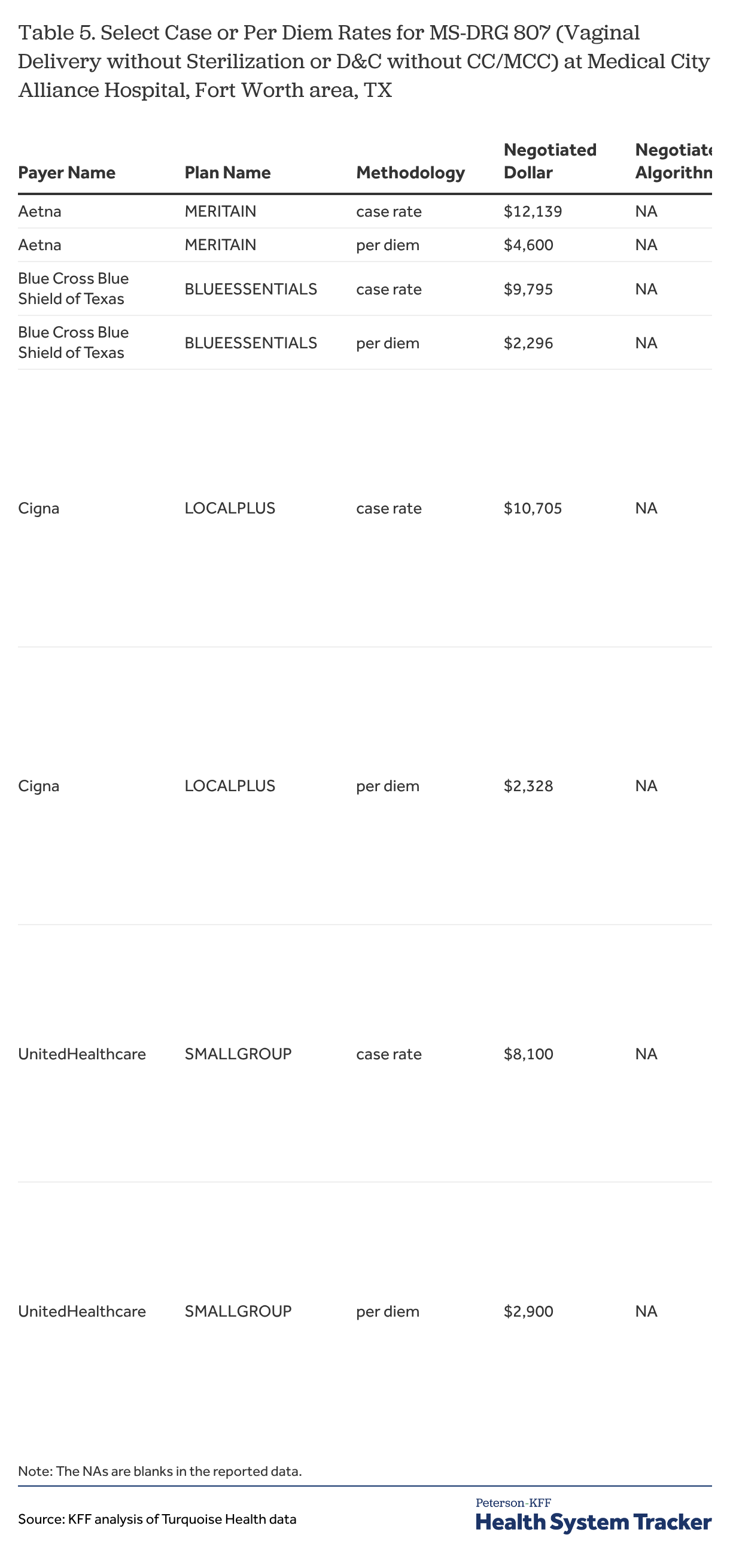
It is not unusual for a payment arrangement to include a set dollar amount for the beginning period of a hospital stay, with a per diem amount then being paid for any additional days. The hospital reporting the rates illustrated[4] in Table 5 reported this arrangement as two different rates, a case rate and a per diem rate, with encoded information in the notes data element that shows how the two rates are connected. This method of reporting does not seem to meet the CMS guidance, which instructs hospitals to encode this type of arrangement in the negotiated algorithm data element, presumably all on one line. The UnitedHealthcare rates in Table 3 provide another example of this type of arrangement, which again is not reported as recommended in the guidance: while the rate is reported on one line, the per diem amount is explained in a notes data element and not in the negotiated algorithm data element. With either method of reporting, the failure to follow the guidance means that the rates were reported without the allowed amount information. These are issues that might be resolved with additional guidance or enforcement of guidelines by CMS, but until that occurs data users need to be aware of these reporting patterns. This may be a particular concern for data users processing large numbers of records as these patterns may be difficult to spot.
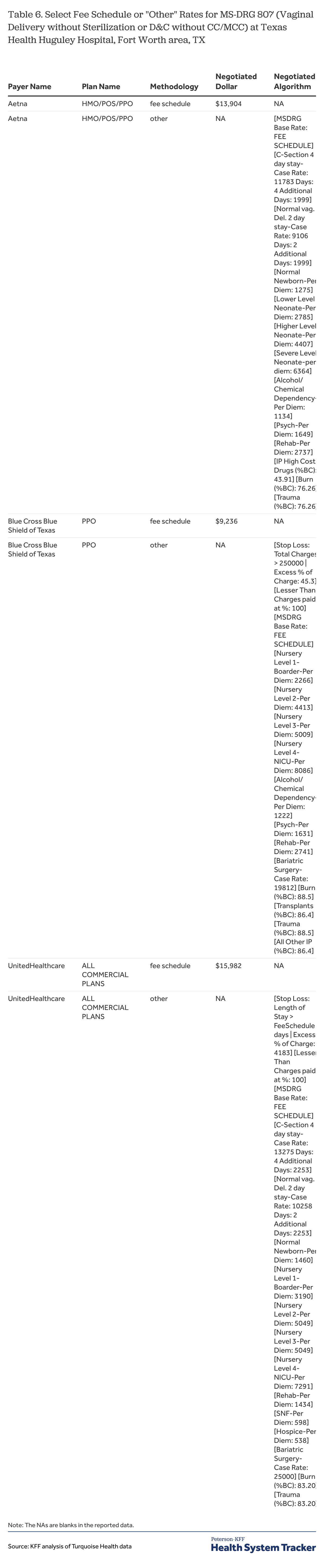
The case rate and per diem arrangement is not the only instance where some hospitals report more than one rate for the same payer and plan combination. A number of hospitals report a fee schedule rate and a negotiated algorithm (with no negotiated dollar amount) as separate rates for the same billing code for the same payer and plan. Table 6 shows several examples from one Fort Worth area hospital.
There is no way to know whether these different rates represent separate arrangements or whether the fee schedule or the algorithm better describes how payments are actually made by the payer to the hospital for that plan. There are many hospitals reporting rates with this pattern, which raises several issues for data users.
One is identifying these cases: this combination of rates is easy for users to miss unless they are looking for it, and many users might simply use the fee schedule rate because it is reported as a dollar amount and dollar amounts seem to be preferred by researchers and others making estimates across large numbers of hospitals and payers. As the table shows, however, the fee schedule rates can be quite different from the allowed amounts reported for rates reported as algorithms.
For users that are able to identify these cases, an additional issue is how much credence, if any, to give to the fee schedule rates if the negotiated algorithm rates are different, particularly if they are supported by a large count of payments. Because there is no count associated with the fee schedule rates in these cases, there is no way to know if they ever have been paid. In the cases illustrated in Table 6, the counts reported for the negotiated algorithm rates are fairly robust and the reported median amounts are noticeably lower than the corresponding fee schedule dollar amounts. Using the fee schedule dollar amounts for these cases might inflate the amounts that the hospital actually receives.
Understanding the Allowed Amount “Count” Element
What to do with the cases where the count for the negotiated algorithm is zero raises another question: if there have been no transactions in the last year for the algorithm, is it fair to assume that that fact also applies to the fee schedule rate (where allowed amounts are not reported nor required), and should this affect how users consider that fee schedule rate? Seeing a count of “Zero” is not uncommon, which is part of a broader issue that is discussed next.
The allowed amount count, when encoded, quite often is zero. As noted above, one of the key revisions to the HPT rule was the inclusion of new allowed amount data elements that hospitals must encode when a rate is reported as a negotiated percentage or a negotiated algorithm. These data elements replaced the “estimated allowed amount,” which was the average dollar amount that the hospital had historically received from the payer for the item or service. CMS stated its belief that the new allowed amounts provided “greater context and clarity with respect to the payer-specific negotiated charge than the estimate allowed amount,” and that the “median, 10th percentile, and 90th percentile allowed amounts will further improve the public’s ability to understand the actual price of care, particularly when making comparisons across hospitals.”[5]
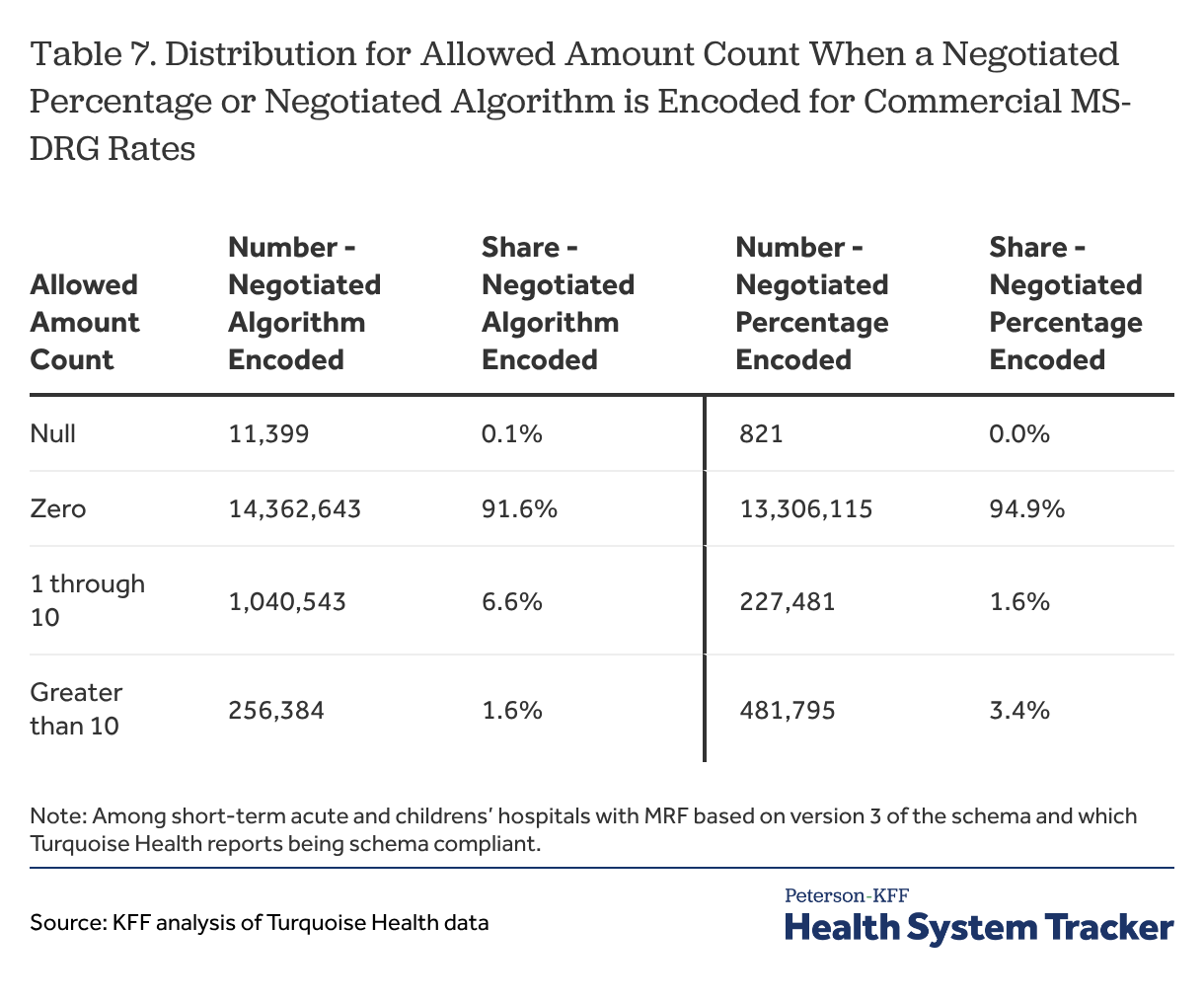
One thing that may surprise data users, however, is how often this information is missing because the allowed amount count is zero. For example, looking across 6,445 hospitals that have uploaded MRFs based on the latest version 3 of the schema, the allowed amount count was zero in 92% of instances in commercial plans for MS-DRG entries when a negotiated algorithm was encoded and in 95% of the instances when a negotiated percentage was encoded. This means that these hospitals are saying that they have not received any payments for these MS-DRGs from the payer and plan during the past 12 to 15 months. Thus, the approach of using observed real-world payments to anchor dollar amounts in cases in which the rate is set by algorithm may still leave data user with substantial amounts of missing information.
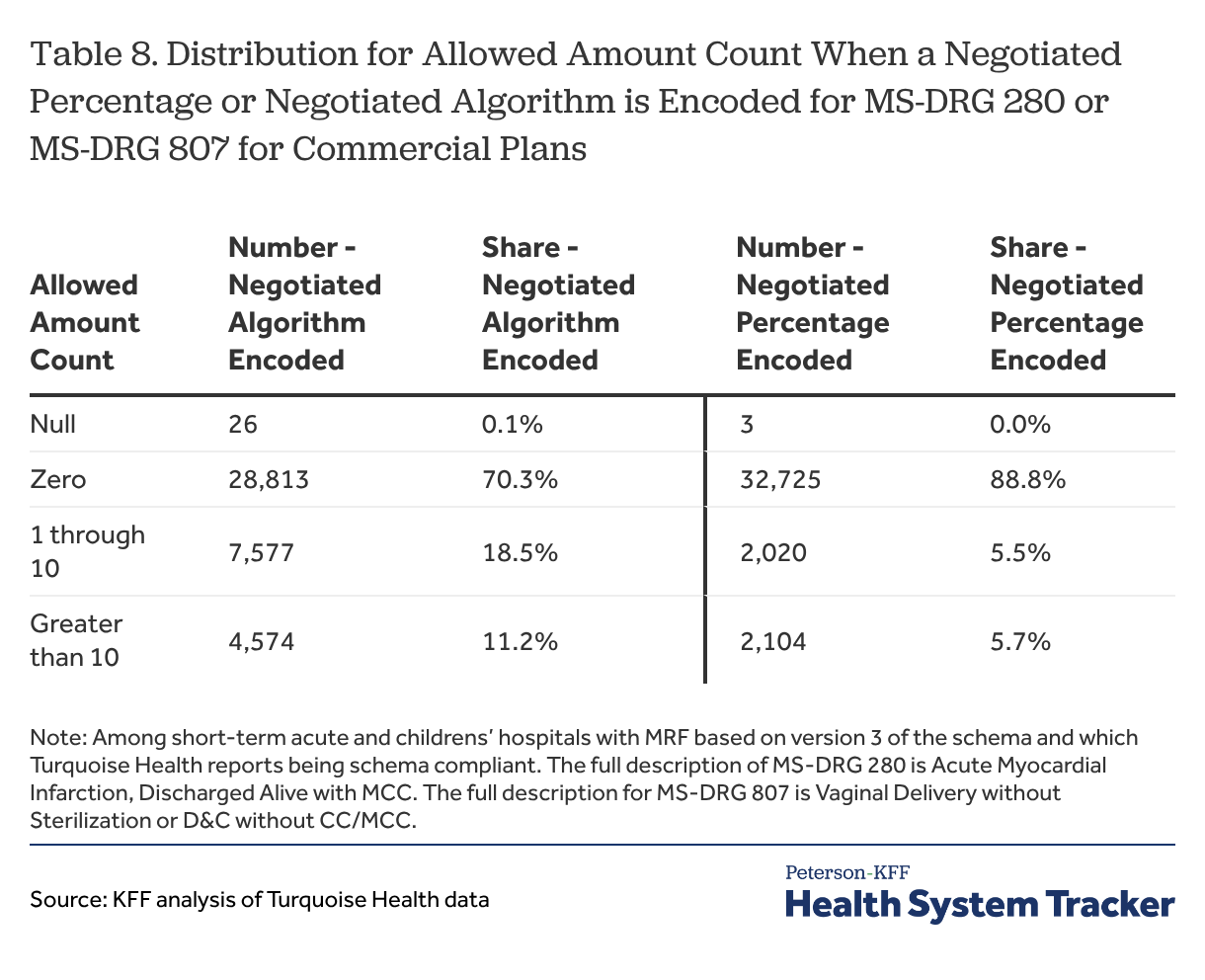
There is some variation around these percentages; for example, just focusing on the two common MS-DRGs (280 and 807) used in the examples above, the allowed amount count was zero in 72% of instances for commercial plans when a negotiated algorithm was encoded and in 91% of the instances when a negotiated percentage was encoded (Table 8).
The high prevalence of zero allowed amount count values raises several issues for data users. One is just the large number of cases where there is no actual payment information to use for comparisons across hospitals. These rates add substantial volume to the MRF and may have no purpose. A second is whether to use any of the information that is provided when the count is zero; for example, in many of these instances hospitals also have encoded a negotiated dollar value as a base rate that could be adjusted by the negotiated percentage or algorithm (see Tables 1 and 2 for examples). In these cases, some users may feel uncomfortable using the negotiated dollar base rate because they know it is not the final rate, particularly if the reported dollar value differs meaningfully from the rates reported for other payers or hospitals in the area. Sorting through these cases may be a particular problem for researchers analyzing a large number of cases as it may be impractical for them to review each of these instances separately.
Understanding Improbable Rates
Another factor that some users may be unaware of when looking at the allowed amount count and other allowed amount values is that they may not be specific to each hospital location within a broader hospital system. When the negotiated rates for a payer and plan are the same for multiple hospitals in a system, the same information is sometimes encoded for each of them. For example, the rates shown in Table 2 for MS-DRG 807 at the Methodist Women’s Hospital in Omaha, Nebraska were also encoded for another hospital in Omaha operating on the same license as well as for two affiliated hospitals operating in Council Bluffs, Iowa, including a behavioral health hospital that does not appear to offer this service (Table 9, highlighted in blue, below). There does not seem to be any explicit guidance on how the allowed amounts should be calculated in these situations. The rule generally provides that: “[e]ach hospital location operating under a single hospital license (or approval) that has a different set of standard charges than the other location(s) operating under the same hospital license (or approval) must separately make public the standard charges applicable to that location.”[6] This seems to be an area where additional guidance may be needed.

It perhaps should not be surprising that hospitals report rates for items and services that they rarely or never provide. The fee schedules, rating formulas and other payment arrangements developed and used by payers in their negotiations with providers may address a very broad range of services, and hospitals and other providers entering into these arrangements are unlikely to provide all or even most of the items and services for which payment rates are provided or can be derived under the arrangement. The problem of “ghost rates” has been a key issue for those using the TiC data reported by payers, and it makes sense that there may be some similar issues for hospitals when they must report all of the rates provided for under their negotiated arrangements with payers.
The introduction of the allowed amount count for a subset of rates provides users with information about how often the hospital actually is paid, albeit there are some questions about how the count should be calculated. This clearly helps those data users who only want to use rates for which the hospital actually has transactions, some of whom now validate rates against claims data acquired from other sources. This new information begs a larger question, however: what to believe about rates where allowed amount count is not required. Is it possible, or even likely, that the prevalence of zero transactions would be as high for these rates as it is for the rates where allowed amount count is observed? Would requiring a count in these cases be a good addition for transparency or would the additional burden outweigh the benefit?
Methods
The data used in this analysis was obtained from HPT machine readable files processed and maintained by Turquoise Health. The information shown and used was downloaded from the Turquoise Health Hospital Data tables between July 17 and August 2, 2026. The analysis is based on data from MRFs reported using the latest version (version 3) of the reporting schema and were further limited to MRFs where the Turquoise Health created indicator variable “is_schema_compliant” was true. Hospitals can update their MRFs at any time, so it is possible that the examples shown no longer represent the most recent information reported by the hospitals identified.
[1] 45 CFR 180.50(a)(3)(iii)
[2] FR 90 53991
[3] There can be one or two notes data elements, depending on the reporting format. The schema has three reporting formats, a JSON format and tall and a wide csv formats. The JSON and tall formats have only an additional generic notes data element while the csv wide format also an additional payer notes data element. Hospitals using the wide format are instructed to “use the ‘Additional Generic Notes’ data element for additional general information and use the ‘Additional Payer-Specific Notes’ data element for additional payer-specific information.”
[4] Medical City Alliance Hospital reported many more payer and plan combinations with the arrangement, as did the other Medical City hospitals in the Forth Worth Area.
[5] Rule at 53989
[6] 45 CFR 180.50(b)
The Peterson Center on Healthcare and KFF are partnering to monitor how well the U.S. healthcare system is performing in terms of quality and cost.