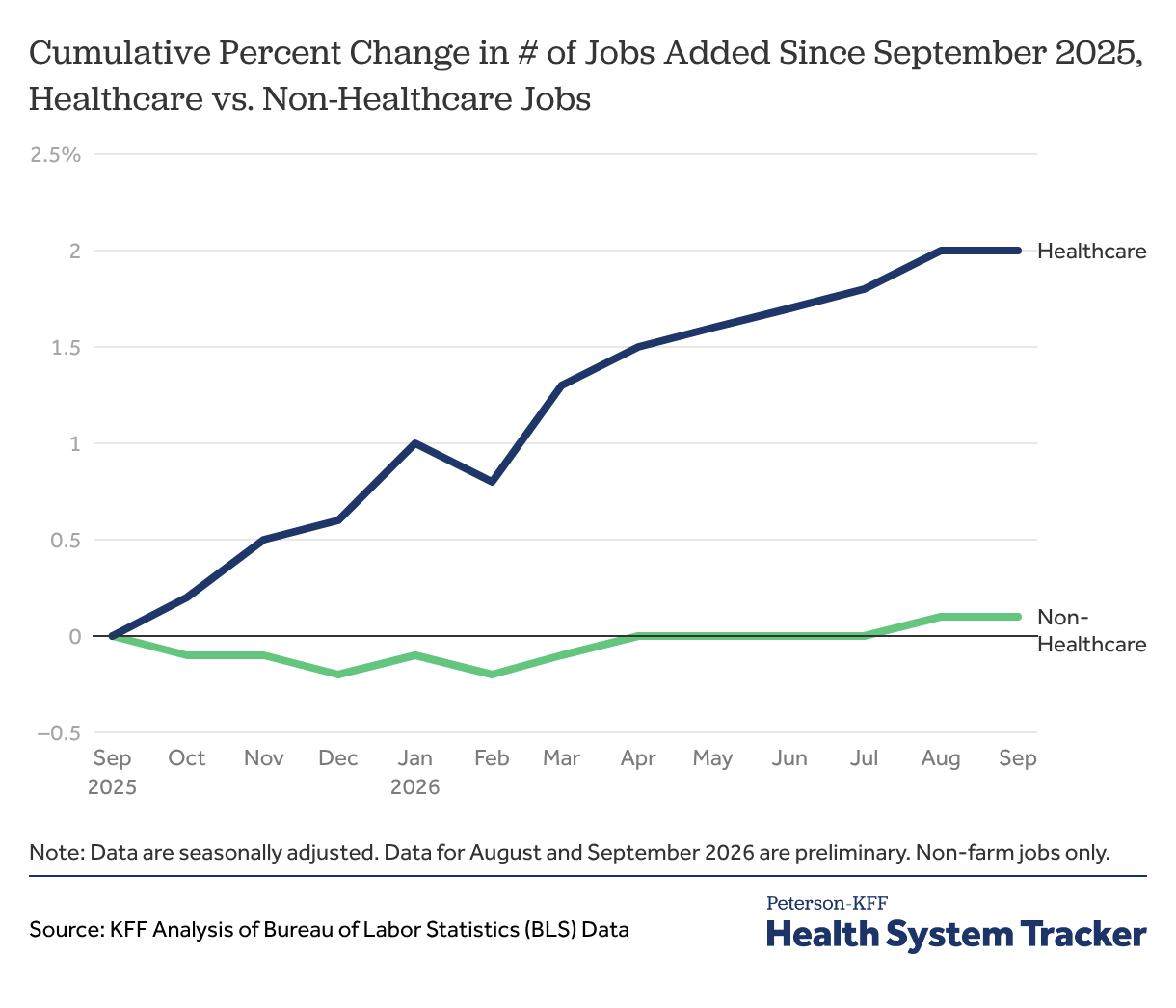
The most recent Bureau of Labor Statistics’ jobs report found that total non-farm payroll employment changed little from August to September of this year, but noted that “Health care employment continued its upward trend in September, but at a slower pace than the average monthly gain over the prior 12 months.” This monthly snapshot reflects an ongoing trend seen in job growth reporting throughout the previous year. While overall employment growth has remained relatively flat from September 2025 to September 2026, employment across a variety of healthcare settings—including jobs in physician offices, hospitals, outpatient care centers, and home health—has continued to grow.
Since September 2025, the healthcare sector has added 372,000 jobs (up 2.0%) while the overall economy apart from the healthcare sector gained 124,000 jobs (up 0.1%).
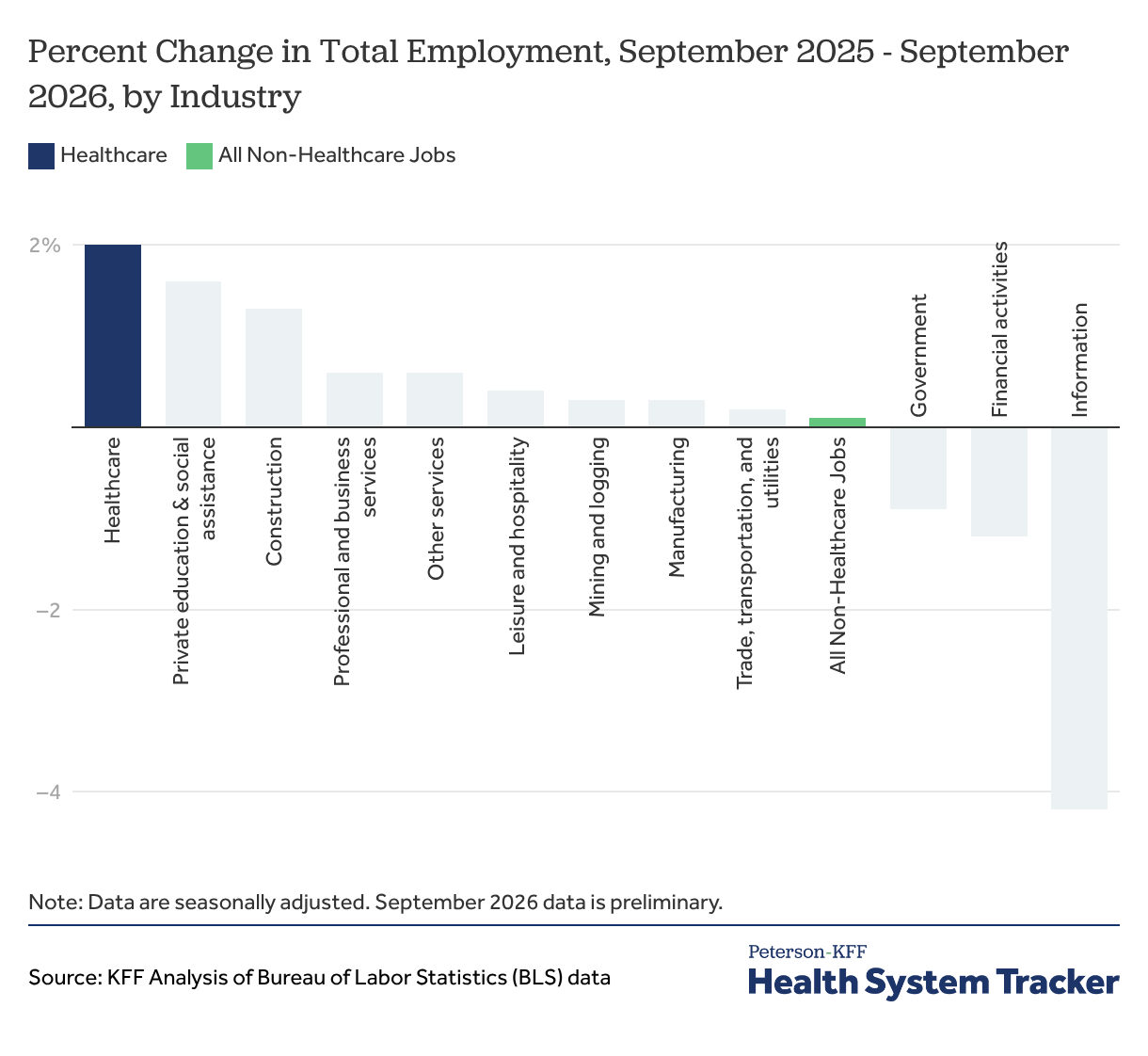
Total non-farm employment grew by 0.3% over the past year, but by just 0.1% when healthcare jobs are excluded. While healthcare is among the fastest-growing sectors, other sectors also added jobs over the past year, including social assistance, private education, construction, leisure and hospitality, professional and business services, and “other services,” which includes repair and personal care services as well as civic, social advocacy, and professional organizations. The relative lack of growth in non-healthcare employment was driven primarily by contractions in the information sectors—which includes publishing, broadcasting, and telecommunications—as well as financial and government sectors.
Healthcare job growth has outpaced job growth in all other economic sectors in the past year.
Over the last decade, several factors may be contributing to the trend of healthcare employment outpacing the rest of the economy. These include increasing demand for healthcare services as the U.S. population ages and the number of individuals living with chronic conditions increases, the relatively high pay for many healthcare professions, and the hands-on nature of many healthcare jobs, which may make them less susceptible to outsourcing or automation. As shown in a related brief looking at long-term employment trends, healthcare has represented a growing share of overall jobs since 2016, and now makes up an all-time high proportion of total jobs (11.7%).
Related Content:

In the short term, healthcare jobs may be more insulated from broader economic downturns or volatility as demand for healthcare is more inelastic than for many other services, and third-party payment from insurers and government programs protects patients from some of the immediate effects of high and rising prices.
However, the coming months and years could bring changes to this trend. While BLS projects that private healthcare and social assistance (a category that combines some health and non-health services) will add the most jobs of any sector through 2035, uncertainty around AI innovation and new major policy changes make long term projections difficult.
Additionally, declines in revenue and patient demand could cause tightening in the healthcare workforce in the coming years. The Congressional Budget Office projects the number of people without health insurance will rise by over 10 million from 2025 to 2036 because of policy changes to the ACA and Medicaid, and some healthcare settings may see a drop in demand and/or an increase in uncompensated care as a result. These revenue strains may place an especially strong squeeze on hospital revenues and their employees, because hospitals are legally mandated to treat and stabilize emergency patients regardless of their ability to pay. The impact of these policy changes on health sector employment, and how they stack up against the forces driving increasing utilization, remains to be seen.
The Peterson Center on Healthcare and KFF are partnering to monitor how well the U.S. healthcare system is performing in terms of quality and cost.