The 2025 federal budget reconciliation law (“The One Big Beautiful Bill Act” or “OBBBA”) aimed to promote the use of health savings accounts (HSAs) for Marketplace enrollees through a variety of provisions, including allowing all ACA-compliant individual market bronze and catastrophic plans sold on and off the Affordable Care Act (ACA) Marketplaces to be HSA-eligible beginning in plan year 2026 regardless of their deductible, out-of-pocket maximum, or benefit design.
Previously, despite having high deductibles, catastrophic plans and most bronze plans did not meet the Internal Revenue Service’s (IRS) definition of a high-deductible health plan (HDHP) due to ineligible pre-deductible benefit coverage and/or their out-of-pocket maximums. The reconciliation law also expanded other HSA eligibility rules — allowing direct primary care arrangements and pre-deductible telehealth coverage in HSA-eligible plans.
This brief examines HSAs in the context of recent changes under the OBBBA to expand access to these HSA-eligible plans and accounts, with a focus on their potential implications for ACA Marketplace enrollees. The availability of plans compatible with an HSA has increased substantially since the implementation of relevant provisions from the OBBBA.
This new environment comes with both benefits and risks for consumers. On the one hand, Marketplace enrollees could benefit from the tax advantages of contributing to an HSA. Additionally, some enrollees with incomes above four times poverty can potentially use tax-deductible contributions to an HSA to become eligible for premium tax credits. On the other hand, enrolling in HSA-eligible Marketplace coverage or contributing to an HSA means signing up for a high-deductible plan and could complicate consumer decisions by requiring them to anticipate future health care costs and income, and weighing health costs against other short-term household expected spending.
What are HSAs?
HSAs are tax-advantaged savings accounts that enrollees in certain HDHPs can use to pay for qualified medical expenses. HSAs were created by the Medicare Prescription Drug, Improvement, and Modernization Act in 2003 to accompany HDHPs, as defined by the IRS. To open and contribute to an HSA, an individual must be enrolled in an HSA-qualified HDHP. The IRS requires HDHPs to meet all the following three criteria:
Related Content:
- Having a deductible equal to or greater than an amount annually determined by the IRS ($1,750 for individual coverage and $3,500 for family coverage in 2027).
- Not covering most care, except preventive care and certain insulin products, until the deductible is met.
- Having a maximum out-of-pocket limit equal to or below the amount annually determined by the IRS ($8,700 for individual coverage and $17,400 for family coverage in 2027).
In addition, to make contributions to an HSA, an individual is not allowed to carry other medical coverage alongside the HDHP. Therefore, medical coverage outside the HDHP could jeopardize HSA-eligibility.
Although there are other tax-advantaged accounts such as Individual Retirement Accounts (IRA), HSAs are unique in offering a “triple tax advantage.” HSA contributions are tax-deductible, investment growth is tax-free with balances rolling over indefinitely (no “use-it-or-lose-it” rule), and withdrawals are tax-free when used for unreimbursed qualified medical expenses incurred after the account was established. After age 65, funds in an HSA can also be withdrawn for non-medical expenses without a penalty, but those withdrawals are subject to income tax.
HSA contributions are restricted to annual limits set by the IRS. In 2027, the limits will be $4,500 for individual coverage and $9,000 for family coverage. Those 55 and older who are not enrolled in Medicare can contribute an additional $1,000. Beyond the account holder, employers (for those with an employer-sponsored HDHP), family members, and any other person may also contribute to an individual’s HSA. Furthermore, the account itself is owned by the individual, not the employer or insurer, which makes it “portable”: it stays with the person through job changes, retirement, or periods of unemployment. After someone enrolls in Medicare, they can no longer contribute to their HSA, though they retain access to funds already in the account.
What changes did the “One Big Beautiful Bill Act” make to HSAs?
The OBBBA changed some of the previously mentioned HDHP requirements in three primary ways:
- Regardless of the pre-deductible benefit design, all bronze and catastrophic plans for individuals and families sold on and off the Marketplaces are HSA-eligible. Previously, these plans often did not qualify as HDHPs for HSA purposes because their broader benefit design frequently failed to meet all IRS requirements. (Note that while off-Marketplace (or “off-exchange”) bronze and catastrophic plans are HSA-eligible, individuals wanting to receive a tax credit to lower their premiums must purchase coverage sold on Healthcare.gov or their state’s ACA Marketplace).
- Individuals enrolled in qualifying direct primary care arrangements are no longer disqualified from making HSA contributions. In the past, direct primary care arrangements were considered to be an additional form of coverage that rendered people ineligible to contribute to an HSA. The law now allows enrollment in certain direct primary care arrangements without disqualifying the individual from HSA eligibility and expands permissible HSA uses to include payments for qualified direct primary care arrangements.
- HDHPs can cover telehealth and remote care services before enrollees meet their deductible without jeopardizing HSA eligibility. This makes permanent a flexibility that was temporarily authorized during the COVID-19 pandemic but had lapsed.
How has HSA plan availability in the ACA Marketplaces changed?
In 2026, as a result of the OBBBA, all bronze and catastrophic plans for individual or family coverage being offered through HealthCare.gov were compatible with HSAs, compared with 6% and 0%, respectively, in 2025. HSA coverage remained uncommon among silver and gold plans, at less than 1% of plans in each metal level in both years.
The share of catastrophic and bronze HealthCare.gov plans that are compatible with HSAs rose sharply in 2026
The total number of plans offering HSA coverage increased from 406 in 2025 to 5,437 in 2026, driven primarily by the expansion among bronze and catastrophic plans. HealthCare.gov offered 5,191 bronze plans with HSA coverage in 2026, up from 309 in 2025, while all 150 catastrophic plans offered HSA coverage in 2026, as compared with none of the 266 in 2025.
How are ACA Marketplace enrollees uniquely positioned to use HSAs?
Historically, ACA Marketplace enrollees have had lower rates of HSA-eligible plan enrollment than people with employer-sponsored coverage. Only 2% of HealthCare.gov enrollees selected an HSA-eligible plan in 2025, compared with 29% of covered workers in employer-sponsored plans. However, as a result of expanded availability of HSA-eligible plans in 2026, nearly 43% of Marketplace enrollees who enrolled through the HealthCare.gov platform were enrolled in HSA-eligible plans in 2026.
In addition to the “triple tax advantage” available to all HSA holders, Marketplace enrollees who choose to contribute to an HSA may have an additional benefit because HSA contributions can reduce the income used to determine eligibility for Marketplace financial assistance.
Premium tax credit and cost sharing reduction (CSR) eligibility and amounts are based on household modified adjusted gross income (MAGI). HSA contributions, like tax-deductible contributions to an IRA or other tax-deductible accounts, are excluded from MAGI. As a result, eligible individuals can potentially lower their MAGI through HSA contributions, and in some circumstances, qualify for a larger premium tax credit. This can be particularly relevant for people whose income exceeds but is near the 400% of the federal poverty level (FPL) (annual income of $63,840 for an individual or $132,000 for a family of four in 2026) threshold (“subsidy cliff”) for premium tax credit eligibility.
The dollar amount of HSA contributions needed to reach a particular income threshold is based on household size and income. HSA and IRA contribution limits also vary by age. Using examples with varying household sizes, annual incomes, age groups, and HSA contributions, we illustrate how Marketplace enrollees may shape their HSA and IRA contribution decisions to reduce their MAGI to 400% FPL for premium tax credit eligibility. (Alaska and Hawaii have different poverty guidelines, so the examples below are illustrative of the contiguous United States).
Marketplace enrollees just above 400% FPL may become eligible for premium tax credits by making tax-deductible contributions
The estimated amount of premium tax credit individuals and families are eligible for is based on age, income, family size, and location. KFF’s Health Insurance Marketplace Calculator is used to estimate 2026 premium tax credits in the scenarios illustrated in Figure 2. Enrollees can consider talking to a tax consultant for assistance in avoiding some or all repayment liabilities.
Considerations for ACA Marketplace enrollees choosing an HSA-compatible plan
HSA contributions reduce MAGI, which can lower income tax liability and increase eligibility for Marketplace financial assistance. However, HSAs also have potential downsides and limitations for consumers. Deciding whether to enroll in an HSA-eligible plan and whether to contribute to an HSA adds to the complexity enrollees already face when choosing a Marketplace plan.
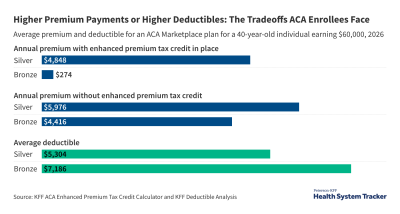
Contributing to an HSA may require enrolling in a plan with higher cost-sharing The OBBBA provisions have increased the number of bronze and catastrophic plans eligible for HSAs, without affecting the number of HSA-eligible plans in higher metal tiers. The average deductible in bronze plans is nearly $7,500 in 2026. Enrollees who incur large out-of-pocket costs may find that paying this deductible outweighs any premium or tax savings from HSA contributions.
Marketplace enrollees with lower incomes may be better off with a cost- sharing reduction (CSR) plan. Marketplace enrollees who are eligible for CSRs (annual income at or below 250% FPL, or $39,900 for an individual or $82,500 for a family of four in 2026) would forgo CSR benefits by enrolling in a bronze or catastrophic plan to open an HSA because CSRs are available only in silver plans. Nearly half of Marketplace enrollees have incomes below 150% FPL (annual income of $23,940 for an individual or $49,500 for a family of four in 2026), making them eligible for significantly reduced deductibles in silver plans. Enrollees at these income levels also may have limited capacity to contribute meaningful amounts to an HSA. Tax-deductible contributions also provide less financial value to lower-income enrollees, who typically pay a lower tax rate.
Income volatility can make targeting a specific income threshold difficult. The calculations also depend on an individual’s actual income for the coverage year, which may be difficult to predict. Marketplace enrollees can experience substantial income volatility. About one in five adults between ages 19 and 64 have a difference of at least 20% between their income reported at the beginning of the year and their actual income at the end of the year, with income volatility particularly common among individual market enrollees and lower-income adults. This can make it difficult for individuals to determine how much they would need to contribute to an HSA or other tax-deductible account to reach a specific income threshold.
Marketplace enrollees must repay excess premium tax credits. If an individual’s actual MAGI is higher than the amount estimated when they enrolled, they may qualify for less in premium tax credits than the amount of premium tax credits paid on their behalf during the year. They must reconcile the advance payments with the amount they are ultimately eligible for when filing their federal income tax return. Beginning with tax year 2026, changes enacted in the OBBBA eliminated the caps on repayment that previously limited how much excess advance premium tax credits certain taxpayers had to repay.
As a result, all individuals who receive more in advance credits than they ultimately qualify for will have to repay the full difference. Households with incomes above 400% FPL are not eligible for premium tax credits, so a small difference in income can determine whether an enrollee receives any financial assistance. HSA contributions may move income below the premium tax credit threshold. Taxpayers who discover when filing their tax returns that their income exceeds 400% FPL and are required to repay a large amount of premium tax credits may be able to make HSA contributions for the tax year to reduce their income below 400% FPL, provided that the contribution does not exceed their remaining HSA contribution limit.
There is limited assistance for Marketplace enrollees to set up an HSA. HSAs must be set up by HDHP enrollees on their own, with a bank. Insurers generally do not assist enrollees with setting up HSAs, although some health plans may partner with banks that offer HSAs. Banks may charge a fee for maintaining an HSA. Unlike with employer plans, which often contract with vendors that can help eligible employees in setting up HSAs, people enrolled in individual market Marketplace plans may not have assistance when they enroll in an HDHP. Fewer Marketplace HDHP enrollees have an HSA when compared to those in employer HDHPs. Some Marketplaces have developed tools to assist their enrollees in setting up HSAs, such as the DC Health Link.
The timing of contributions can complicate eligibility. Marketplace financial assistance is initially based on projected household income for the coverage year, though it is reconciled after the fact based on actual income. During Open Enrollment, enrollees report their expected income for the upcoming year, which can account for anticipated deductible HSA or IRA contributions. However, some enrollees may not decide to make contributions, or may not know how much they will contribute, until after the coverage year begins. These enrollees can update their Marketplace application during the coverage year if their expected income changes, potentially increasing the amount of premium tax credits they receive.
The applicable federal poverty level for determining eligibility is based on the poverty guidelines in effect at the start of the Open Enrollment period for that coverage year, rather than guidelines published later in the coverage year. For instance, people signing up for 2027 coverage should use 2026 federal poverty guidelines to determine their poverty level based on their expected 2027 income.
The amount needed to reach a subsidy threshold may exceed annual contribution limits. HSAs and IRAs have annual contribution limits. As shown in Scenario 3 of Figure 2, the amount that would need to be contributed to tax-deductible accounts by a couple who is earning at 709% FPL, to reach the income threshold for premium tax credit eligibility is $65,400 which exceeds the maximum amount this family is allowed to contribute to these accounts in 2026 ($27,950). In these cases, tax-deductible contributions alone would not be sufficient to reduce MAGI enough to qualify for financial assistance.
Premium tax credits are only available on-Marketplace and cannot be applied to catastrophic plans. While individual market bronze and catastrophic plans are available off Marketplace, to receive a tax credit, enrollees must purchase a plan sold on Healthcare.gov or their state’s Marketplace. Although catastrophic plans are now HSA-eligible, premium tax credits cannot be used to lower premiums for these plans. To receive premium tax credits, an enrollee must enroll in a plan in one of the four metal tiers. Because very few silver and gold plans are HSA-eligible, this generally means that most people using an HSA to become eligible for a tax credit will be limited to bronze plans.
Acknowledgments
The authors would like to thank Roy Ramthun of HSA Consulting Services, Jason Levitis of the Urban Institute, and Purvee Kempf of DC Health Link for their review.
The Peterson Center on Healthcare and KFF are partnering to monitor how well the U.S. healthcare system is performing in terms of quality and cost.